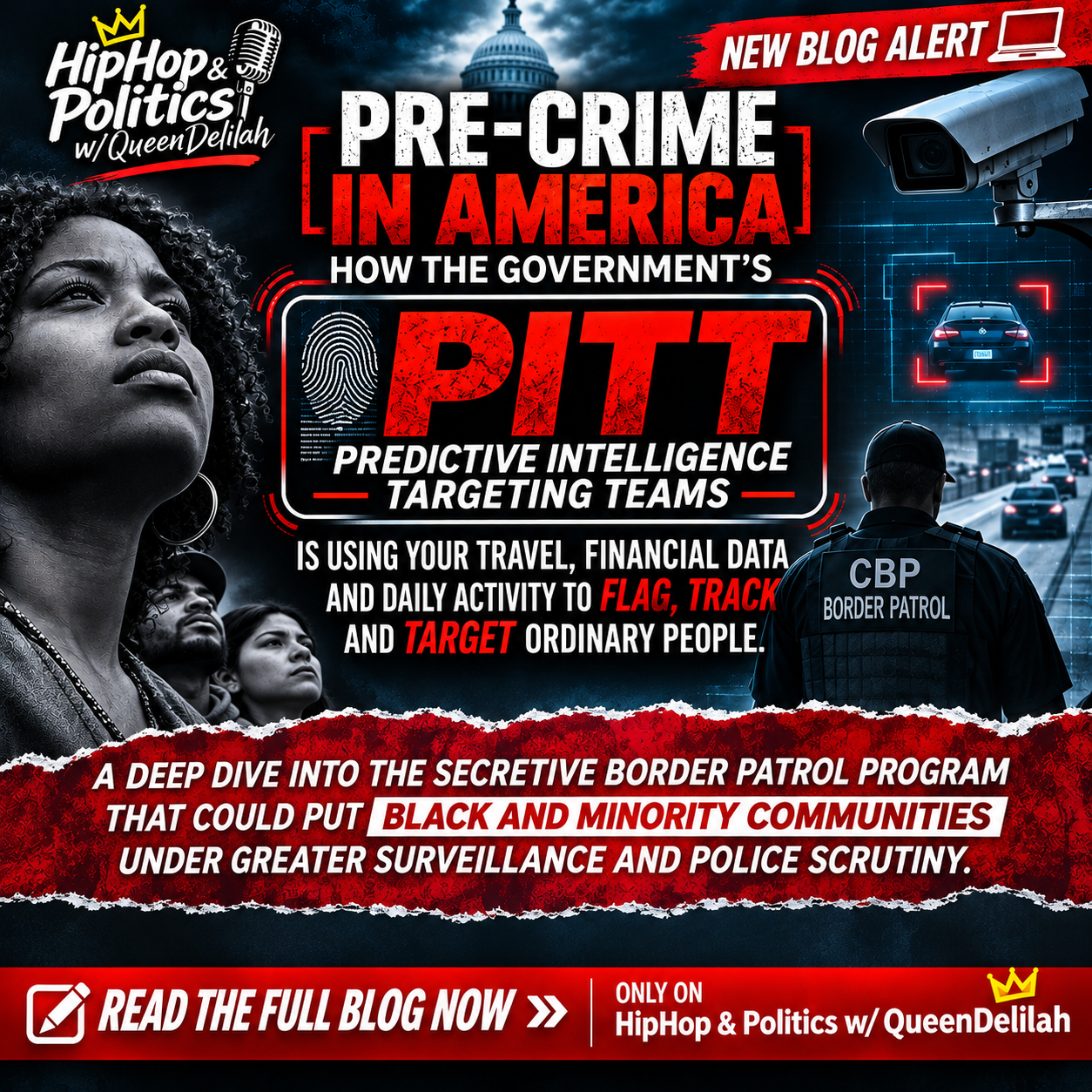
PRE-CRIME IN AMERICA: WHEN THE GOVERNMENT STARTS TREATING ORDINARY PEOPLE LIKE SUSPECTS
How a secretive Border Patrol intelligence program is raising serious questions about surveillance, racial profiling, financial privacy and constitutional rights in Black and minority communities.
What if your everyday life became evidence against you?
Imagine driving home after visiting relatives in another state. You stop for gas, withdraw money from an ATM and continue along a highway you have traveled dozens of times.
You haven't committed a crime. You haven't been accused of one. You have no reason to believe anyone is investigating you.
But somewhere inside a federal intelligence system, your travel patterns or financial activity may be considered unusual.
Your vehicle could be flagged. Information about you could be forwarded to a local police officer. And the next thing you know, you're pulled over for a traffic violation without realizing that a federal intelligence assessment may have helped put you on that officer's radar.
This isn't simply the plot of a futuristic crime thriller.
Investigative reporting has revealed that the U.S. Border Patrol operates units known as Predictive Intelligence Targeting Teams (PITTs), which analyze information about individuals to identify potential law-enforcement targets.
And while the federal government presents intelligence-led policing as a tool for combating criminal activity, this program raises a much larger question:
How much freedom are Americans willing to surrender to a government that increasingly relies on data to decide who deserves suspicion?
For Black Americans, Latino communities, immigrants and other historically over-policed populations, that question carries particular significance.
Our concern is not that law enforcement uses technology to investigate crimes. Our concern is the expansion of surveillance systems that can direct police attention toward people without publicly explaining the criteria used to identify them.
When government surveillance becomes increasingly powerful but less transparent, constitutional rights become harder to defend.
1. Meet the Predictive Intelligence Targeting Teams
In September 2026, investigative journalist Joseph Cox of 404 Media exposed the name of a little-known Border Patrol intelligence operation: Predictive Intelligence Targeting Teams.
These units are not a newly established independent federal agency. They operate within U.S. Customs and Border Protection, under the Department of Homeland Security.
Reporting has identified PITT operations in at least two Border Patrol sectors: Spokane, Washington, and Laredo, Texas.
According to the investigation, analysts use law-enforcement-sensitive information to identify people whose activities they consider potentially connected to criminal behavior.
The information described in reporting includes:
Automated license plate reader records that can reveal where vehicles have traveled.
Financial activity patterns considered potentially suspicious.
Prior arrests and other law-enforcement records.
Intelligence reports and information shared between agencies.
Travel histories and behavioral patterns used to develop investigative leads.
The most troubling aspect is not merely the amount of information being collected.
It is what happens after that information is analyzed.
Investigators reported that federal analysts can prepare intelligence packages and share them with state or local law enforcement, potentially leading to traffic stops.
A person may therefore encounter police without knowing that a federal intelligence assessment helped initiate the encounter.
The public still lacks answers to basic questions: How many people are monitored? What financial records are accessed? What standards determine suspicious behavior? How many resulting stops produce evidence of criminal wrongdoing?
Until those questions are answered, the program deserves serious public scrutiny.
Source: 404 Media, A Secretive DHS 'Predictive Policing' Unit Is Analyzing Americans' Financial Habits and Pulling Them Over, September 8, 2026.
2. When your driving habits become suspicious
One of the most significant concerns involves automated license plate readers.
These systems capture license plate information as vehicles pass cameras installed along roads, highways and other locations.
License plate readers can serve legitimate investigative purposes, including locating stolen vehicles and identifying cars associated with criminal investigations.
But large networks of readers can also create extensive records of people's movements.
The Associated Press investigated a Border Patrol program that monitors American drivers and identifies travel patterns considered suspicious.
According to the AP, federal authorities have used information about vehicle routes and travel histories to identify people for additional law-enforcement attention.
That raises an uncomfortable question.
Since when did taking an unusual route become a reason to suspect someone of criminal activity?
Consider the ordinary reasons people travel.
A home health aide may drive between several counties every day. A construction worker may take different routes depending on the jobsite. A truck driver may travel across state lines several times a week. A college student may visit family in another city. A small-business owner may make repeated trips to suppliers or customers.
None of these activities establishes criminal intent.
Yet an automated system may lack the context needed to understand why someone travels the way they do.
That is the fundamental danger of treating unusual behavior as inherently suspicious.
A pattern can identify something worth investigating. It cannot, by itself, establish guilt.
3. The financial surveillance question
The 404 Media investigation also revealed that Border Patrol analysts had considered financial activity patterns when identifying potential enforcement targets.
The Electronic Privacy Information Center (EPIC), a nonprofit privacy advocacy organization, subsequently criticized the practice and called for greater transparency.
Financial information is especially sensitive because spending and transaction records can reveal intimate details about people's lives.
They may suggest where someone works, which businesses they support, what medical services they use, where they travel and whom they financially assist.
For minority communities, this creates questions about how ordinary financial activity might be interpreted by systems that lack cultural, economic or personal context.
Consider someone who frequently sends money to relatives abroad.
Or a self-employed worker whose income fluctuates from month to month.
Or a small-business owner who makes regular cash deposits.
Those activities may be entirely lawful.
Financial institutions already operate under federal anti-money-laundering requirements, and law enforcement has legitimate authority to investigate financial crimes. But that authority should be accompanied by clear legal safeguards, appropriate oversight and accountability.
The public deserves to know whether intelligence analysts are using financial records obtained through warrants, subpoenas, commercial databases or other lawful channels.
As of the reporting reviewed, the precise source of the financial information used by PITT analysts had not been publicly established.
That distinction matters. We should not assume unlawful access without evidence, but neither should the government expect the public to accept undisclosed financial surveillance without meaningful scrutiny.
4. The Montana traffic stop that exposed the system
One case examined by investigative reporters involved Kyle William Olson, who was stopped by a Montana Highway Patrol officer in May 2026.
The officer cited an allegedly obstructed license plate.
However, a Department of Homeland Security memorandum disclosed in the criminal case revealed that a Border Patrol analyst had reviewed information about Olson before the stop.
The intelligence included references to financial activity patterns associated with narcotics trafficking.
The analyst had shared information with state law enforcement.
The stop subsequently led to criminal charges.
This case illustrates an important distinction: a person can be stopped for an alleged traffic violation while a separate intelligence investigation has already brought that person to police attention.
The legal questions are complicated.
Police may, under established Supreme Court precedent, conduct certain traffic stops when they have an objectively valid legal basis, even if they also possess another investigative motive.
But the existence of a lawful traffic violation does not automatically resolve every question about how intelligence was collected, whether subsequent searches were constitutional or whether relevant evidence must be disclosed to the defense.
This brings us to one of the most concerning concepts in modern law enforcement.
Parallel construction: Can the government hide how an investigation really began?
Parallel construction refers to practices in which investigators create or rely on an alternative investigative explanation that conceals the original source of evidence or an investigative lead.
Human Rights Watch has documented concerns about the practice in federal criminal investigations.
Not every intelligence-led traffic stop constitutes unlawful parallel construction. The legal analysis depends on the facts, the applicable disclosure requirements and whether investigators concealed material information.
But when federal intelligence contributes to an investigation and the defendant cannot meaningfully examine its origin, the fairness of the criminal process becomes a legitimate concern.
How can someone challenge an investigative method they do not know was used?
How can a defense attorney test the reliability of an algorithm without access to the underlying methodology?
And how can a court determine whether a system is discriminatory if the government refuses to disclose how it identifies targets?
These are not abstract questions.
They go directly to the right to challenge government evidence and receive a fair trial.
5. Why Black and minority communities have reason to be concerned
America's history of racial profiling did not begin with artificial intelligence.
Black Americans have experienced generations of unequal treatment in policing, from discriminatory enforcement practices to documented disparities in stops, searches and arrests.
Latino communities and immigrants have also faced heightened scrutiny in immigration and border enforcement.
That history matters because predictive policing systems do not operate independently of the society that produces their data.
They may rely on information generated by previous policing decisions.
If certain neighborhoods have historically experienced more police activity, those neighborhoods may produce more recorded incidents, arrests and enforcement data.
A predictive system that relies heavily on such records can reinforce the patterns it was designed to analyze.
The result may be a feedback loop:
More enforcement produces more recorded incidents.
More recorded incidents make an area appear more suspicious.
That designation can lead to additional enforcement.
And the cycle continues.
This is a recognized concern in research and advocacy surrounding predictive policing.
It does not mean that every algorithm discriminates or that PITT has been proven to target Black Americans disproportionately.
No publicly verified PITT-specific racial-disparity analysis was established in the sources reviewed for this article.
That absence is itself a reason to demand independent evaluation.
If the government believes its system operates fairly, it should be able to demonstrate that through meaningful audits, appropriate disclosure and measurable results.
Civil rights should not depend on the public simply trusting that an undisclosed system is unbiased.
6. The constitutional rights at stake
The controversy surrounding predictive policing extends beyond technology.
It involves fundamental constitutional protections.
The Fourth Amendment: Protection against unreasonable searches and seizures
The Fourth Amendment protects people against unreasonable government searches and seizures.
The government has lawful investigative powers, but those powers are not unlimited.
The legal requirements depend on the type of information collected, how it was obtained and the nature of any resulting stop or search.
For example, the Supreme Court has recognized important privacy protections for certain forms of prolonged location tracking and historical cellphone location information.
Automated license plate data and financial records raise related but legally distinct questions.
A camera recording a license plate on a public roadway is not automatically unconstitutional. Nor does every government request for financial information require the same process as a search of a private home.
Nevertheless, extensive aggregation of location and financial records can reveal details about a person's life that no single observation would disclose.
Congress and the courts must address whether existing safeguards are sufficient for modern surveillance systems.
The Fourteenth Amendment: Equal protection
The Equal Protection Clause prohibits unconstitutional discrimination by government actors.
If a surveillance program intentionally targets people because of race or another impermissible classification, serious constitutional questions arise.
Proving such a claim generally requires more than showing that a program has unequal outcomes.
That is why access to reliable data, program rules and investigative records matters.
Without transparency, potential discrimination becomes harder to detect and challenge.
Due process and the right to a fair defense
People accused of crimes must have meaningful opportunities to challenge the government's evidence.
If automated intelligence played a substantial role in identifying a defendant, courts may need to address what information must be disclosed and whether the defendant can test its reliability.
A system should not become immune from legal scrutiny simply because the government labels its methodology sensitive.
7. The government's argument deserves examination
Supporters of intelligence-led policing argue that modern criminal networks use technology, transportation systems and financial infrastructure to conceal illegal activity.
They contend that law enforcement must use sophisticated analytical tools to identify trafficking networks, detect organized crime and prevent threats to public safety.
That argument should not be dismissed.
Human trafficking, drug trafficking, financial fraud and organized criminal activity are real problems with real victims.
Law enforcement has a legitimate responsibility to investigate them.
But effectiveness and constitutional accountability are not opposing goals.
A system can be technologically advanced and still make mistakes.
It can produce investigative leads while also generating false positives.
It can assist legitimate investigations while lacking adequate safeguards against misuse.
The question is not whether police should ever analyze information.
The question is whether the government has established clear limits, reliable evidence standards, independent oversight and effective remedies when innocent people are targeted.
Public safety cannot become an unlimited justification for secret surveillance.
8. The problem with treating algorithms as objective
Technology often receives a level of credibility that human judgment does not.
When a computer identifies someone as suspicious, its conclusion may appear scientific, neutral or precise.
But algorithms are created by people.
They depend on selected data, assumptions, definitions and operational objectives.
A system designed to identify unusual travel patterns must first define what counts as unusual.
A system evaluating financial activity must determine what patterns merit attention.
Those decisions can reflect incomplete data, flawed assumptions or existing enforcement priorities.
The public therefore needs to know whether these systems have been independently validated.
How often do they correctly identify criminal activity?
How often do they flag innocent people?
Do their error rates differ across demographic groups?
Are officers trained to understand the limitations of algorithmic assessments?
And are there consequences when a system produces repeated false positives?
Without those answers, the claim that predictive policing makes communities safer remains insufficiently demonstrated.
9. What this means for Black economic mobility and minority-owned businesses
The implications extend beyond criminal justice.
Small-business owners, independent contractors, gig workers, truck drivers and entrepreneurs often have financial and travel patterns that differ from traditional salaried employment.
Their transactions may be irregular. Their travel may be extensive. Their business relationships may cross state or national borders.
These activities are not inherently suspicious.
Yet systems that rely on poorly contextualized financial or travel information could expose legitimate economic activity to unnecessary scrutiny.
For Black and minority entrepreneurs, the potential consequences deserve examination.
A traffic stop can interrupt deliveries, delay appointments or interfere with employment.
An investigation can create legal expenses and reputational concerns.
A mistaken suspicion can impose costs even when no criminal wrongdoing is established.
The broader concern is that surveillance errors may become another barrier to economic opportunity.
That possibility requires evidence-based investigation rather than assumptions about how the PITT program treats particular communities.
But it is a sufficiently serious risk to justify public disclosure and oversight.
10. What Congress should demand from Homeland Security
The public should not have to rely exclusively on leaked documents and investigative journalism to understand how a federal surveillance program operates.
Congress has oversight responsibilities, and those responsibilities should include examination of predictive policing.
At minimum, a credible investigation should demand answers to the following questions.
First: What is the program's legal authority?
DHS should explain the statutes, regulations and policies governing PITT operations.
Second: What information is collected?
The agency should disclose the categories of financial, location and commercial data used, along with the legal mechanisms through which those records are obtained.
Third: How are people selected for scrutiny?
Lawmakers should examine the standards used to identify suspicious behavior and whether those standards are supported by reliable evidence.
Fourth: What are the program's actual results?
Congress should seek information about referrals, traffic stops, searches, arrests, prosecutions, false positives and cases that produce no evidence of criminal wrongdoing.
Fifth: Has the system been audited for discrimination?
Independent reviewers should examine whether the program creates unjustified disparities based on race, ethnicity, national origin or other protected characteristics.
Sixth: What information is disclosed to defendants?
The government should explain how it satisfies constitutional and statutory disclosure obligations when predictive intelligence contributes to an investigation.
Seventh: Who is accountable when the system gets it wrong?
People harmed by improper surveillance or unlawful enforcement need meaningful avenues to challenge those actions.
These are not unreasonable demands.
They are basic expectations for a government exercising substantial investigative power.
11. The Black community has seen this pattern before
American history contains repeated examples of government surveillance justified in the language of national security and public order.
During the twentieth century, the FBI's COINTELPRO operations targeted civil-rights organizations, Black political activists and other groups.
The government's surveillance and disruption of lawful political activity became a major example of the dangers of unchecked intelligence powers.
That history does not prove that PITT is equivalent to COINTELPRO.
The programs operated in different periods, under different authorities and with different publicly documented objectives.
But the historical lesson remains relevant.
Government surveillance programs must be evaluated not only by their stated intentions, but by their methods, safeguards and actual effects.
The same constitutional principles that protect a person accused of wrongdoing also protect journalists, activists, business owners and ordinary citizens who have done nothing illegal.
A free society cannot operate on the assumption that every person should be continuously monitored simply because someone might eventually commit a crime.
12. Our position: Public safety must not come at the expense of constitutional freedom
At HipHop & Politics, we believe the public deserves both safety and liberty.
We recognize the legitimate role of law enforcement in investigating organized crime, trafficking and threats to public security.
But we oppose the expansion of opaque predictive surveillance systems that direct police attention toward people without adequate public accountability.
We oppose the use of secret or unvalidated analytical methods when individuals cannot meaningfully challenge the information used against them.
We oppose surveillance practices that reproduce racial discrimination, whether through intentional profiling or poorly designed systems that reinforce existing inequalities.
And we oppose the idea that ordinary financial activity, lawful travel or association should be treated as sufficient evidence of criminal intent.
Our position is not that every intelligence tool must be abolished.
It is that programs capable of generating intrusive enforcement actions should not operate without clear legal limits, independent testing, transparent oversight and enforceable constitutional protections.
If DHS cannot demonstrate that PITT meets those standards, Congress should consider restricting or suspending the program's most intrusive practices until those safeguards are established.
Black communities, immigrant communities and every other American community deserve a government that protects their rights while protecting public safety.
Those obligations are not mutually exclusive.
Final thoughts: Who watches the watchers?
Predictive policing is often presented as the future of law enforcement.
But technological progress should not be confused with democratic progress.
A surveillance system can process millions of records and still fail to understand the circumstances of an individual life.
It can identify unusual behavior without identifying a crime.
It can create suspicion without establishing wrongdoing.
And it can expand government power faster than the public develops the tools needed to hold that power accountable.
The most important question is not whether government technology can become more powerful.
It is whether the people subject to that technology will retain meaningful control over their constitutional rights.
For Black Americans and other historically marginalized communities, the history of unequal policing makes this conversation especially urgent.
But the stakes belong to everyone.
Because once surveillance powers become normalized, the people affected may extend far beyond the communities initially subjected to the greatest scrutiny.
Freedom should not require proving your innocence to an algorithm.
And public safety should never require abandoning the constitutional principles that government exists to protect.
Real People. Real Issues. Real Conversations.
Because Eventually, Politics Comes Home.
Sources and further reading
404 Media — September 8, 2026.A Secretive DHS 'Predictive Policing' Unit Is Analyzing Americans' Financial Habits and Pulling Them Over. Original reporting by Joseph Cox.
https://www.404media.co/tag/border-patrol/Associated Press — 2025.Border Patrol is monitoring US drivers and detaining those with 'suspicious' travel patterns.
https://www.ap.org/news-highlights/spotlights/2025/border-patrol-is-monitoring-us-drivers-and-detaining-those-with-suspicious-travel-patterns/Electronic Privacy Information Center — October 2026.CBP's Predictive Policing Units Have Financial Data, Won't Say How They Got It.
https://epic.org/cbps-predictive-policing-units-have-financial-data-wont-say-how-they-got-it/FindLaw — September 2026.U.S. Border Patrol Using Financial Data of Americans to Direct Traffic Stops, Report Says.
https://www.findlaw.com/legalblogs/criminal-defense/u-s-border-patrol-using-financial-data-of-americans-to-direct-traffic-stops-report-says/Human Rights Watch — January 2018.Dark Side: Secret Origins of Evidence in US Criminal Cases.
https://www.hrw.org/report/2018/01/09/dark-side/secret-origins-evidence-us-criminal-casesU.S. Government Accountability Office.Border Patrol: Actions Needed to Improve Checkpoint Oversight and Data.
https://www.gao.gov/products/gao-22-104568
HipHop & Politics w/ QueenDelilah
https://hiphopandpolitics.org
Editorial disclosure: This article is an opinionated, evidence-based examination of predictive policing and civil liberties. It distinguishes documented program practices from potential risks, unresolved allegations and policy recommendations. It does not assert that PITT has been judicially found unconstitutional or proven to discriminate against a specific racial or ethnic community.