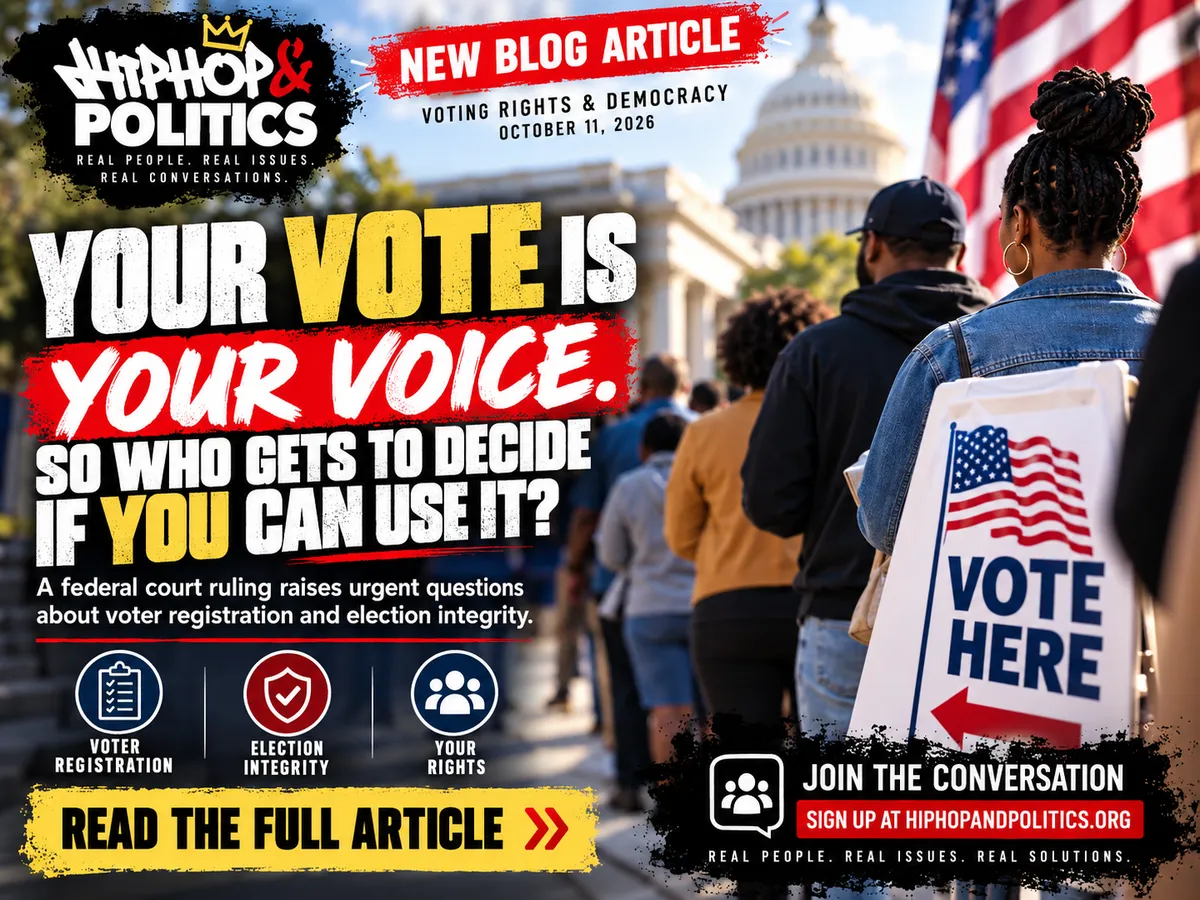
Your Vote Is Your Voice. So Who Gets to Decide If You Can Use It?
Now listen, family. We need to have a conversation about voting rights. And before anybody scrolls past because politics gives them a headache, this one concerns you.
Whether you're Republican, Democrat, independent, or somebody who has completely given up on both parties, your right to participate in elections is one of the most important protections you have as an American citizen.
And this week, a federal court ruling brought a serious question into the national spotlight:
Who gets to decide whether an eligible American can vote?
What happened this week?
On October 9, 2026, Reuters journalist Luc Cohen reported that U.S. District Judge Sparkle Sooknanan ruled against the Justice Department's effort to obtain state voter registration records, compare them with a federal immigration database, and pressure states to remove people identified as potentially ineligible.
The judge determined that the challenged policy was unlawful and raised concerns that inaccurate federal information could lead to eligible citizens being removed from voter rolls.
The Trump administration has argued for stronger measures to identify ineligible voters and protect election integrity. The Justice Department said it was reviewing the decision.
The ruling does not mean states cannot maintain accurate voter registration records. It addresses the legality of this particular federal approach.
And that's an important distinction.
Election integrity and voting rights should work together
I believe we should all be able to agree on two principles.
Elections should be secure, and eligible citizens should be able to vote without improper interference.
Those ideas are not enemies.
They are supposed to be partners.
But the challenge arises when the systems designed to verify eligibility contain outdated or incomplete information.
According to Reuters, the federal SAVE database could identify some naturalized American citizens as noncitizens because their citizenship records had not been updated accurately.
Imagine going through the legal process of becoming an American citizen, registering to vote, and preparing to participate in an election, only to discover that a government database still has you listed incorrectly.
That's not a small administrative inconvenience.
That could affect a person's ability to exercise a fundamental right.
Why this matters to our communities
Let's bring this conversation home.
In communities across America, especially those with large immigrant and naturalized-citizen populations, voter registration accuracy is more than a technical discussion.
It is a question of representation.
When eligible people are incorrectly excluded from elections, their concerns about housing, public safety, education, employment, healthcare, and neighborhood development may go unheard at the ballot box.
And those concerns are not limited to any one political party or ethnic community.
The integrity of our democratic process affects everyone.
A voting system that protects against fraud while protecting eligible voters is stronger than one that sacrifices either principle.
Democracy requires more than showing up every four years
Here's where I'm going to put my teacher hat on for a moment.
Some of us can tell you every detail about a celebrity breakup, every lyric from a new album, and exactly what somebody said on a reality show last Tuesday.
But ask who represents our district in Congress, and suddenly the room gets quiet.
Family, we have to do better.
And I say that with love.
Our elected officials make decisions affecting schools, taxes, infrastructure, public safety, and the future of our communities.
Understanding those decisions is part of protecting our interests.
The November 3, 2026, midterm elections are approaching, making voter education particularly important.
What can we do right now?
First, verify your voter registration through your official state or county election office.
Second, learn which candidates and ballot measures will appear in your election.
Third, understand the responsibilities of the offices you're voting to fill.
And fourth, share accurate election information with your family, neighbors, and community.
Do not rely exclusively on a social media post to determine your voting eligibility, polling location, or registration status.
Use official election resources.
QueenDelilah's community challenge
This week, I challenge you to contact three people and encourage them to verify their voter registration.
Not tell them who to vote for.
Not argue with them about their political preferences.
Just help them understand how to participate.
Because protecting democracy doesn't begin with telling people what to think.
It begins with making sure they have the information and opportunity to make their own decisions.
Your vote is your voice. Your voice deserves to be heard.
Join the conversation
Have you ever experienced difficulty registering to vote, updating your information, or understanding the election process?
What do you believe would make elections both more secure and more accessible?
Join our community at HipHopandPolitics.org. Sign up, share your experience, and help us build a space where political education is practical, respectful, and available to everyone.
We can disagree on candidates while agreeing that every eligible American deserves a fair opportunity to participate.
That's a conversation worth having.
Reporting referenced
Reuters, Luc Cohen, October 9, 2026: US judge rules Justice Department use of voter rolls unlawful