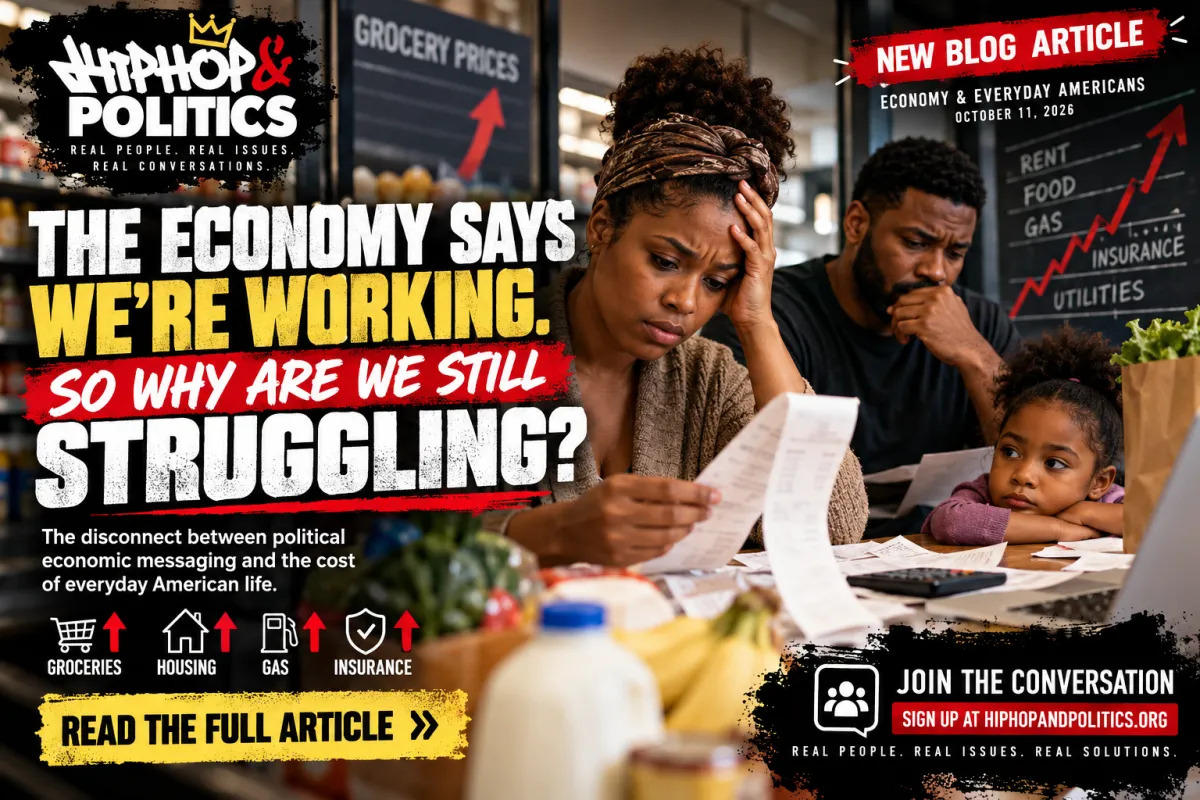
The Economy Says We're Working. So Why Are We Still Struggling?
Let me ask you something. When was the last time you walked into a grocery store, picked up five things, and didn't feel personally attacked by the total at checkout?
Because somebody needs to explain how we're hearing about a strong economy while everyday Americans are standing in the checkout line doing mental gymnastics to decide what goes back on the shelf.
And no, we're not talking about luxury purchases. We're talking about eggs, milk, gas, insurance, housing, and the everyday necessities that keep a household functioning.
Welcome to the American economy in 2026, where the unemployment numbers may look respectable, but the family budget is telling an entirely different story.
What happened this week?
On October 9, Reuters published findings from a Reuters/Ipsos poll showing that 78% of Americans surveyed blamed President Donald Trump's policies for rising living costs, including majorities of Democrats and Republicans.
The report also found that 57% of Republican respondents believed prices were increasing faster than wages. The poll surveyed 4,506 adults, with margins of error of approximately two to three percentage points.
Earlier in the week, Reuters examined another important economic contradiction: unemployment was around 4.2%, yet hiring had slowed, workers were changing jobs less frequently, and wage increases were delivering limited relief from inflation.
Now, before we start arguing over who voted for whom, let's establish something.
An economic statistic is not the same thing as economic security.
And that distinction matters.
Having a job doesn't automatically mean you can afford to live
There was a time when people believed that if you worked hard, showed up, paid your bills, and made responsible decisions, you could gradually build a stable life.
Today, plenty of people are doing exactly that and still struggling to get ahead.
Some households have two working adults and are barely making ends meet. Others have seniors trying to stretch fixed incomes across increasing expenses. Young adults are wondering whether independent living is even financially realistic.
When rent increases, insurance premiums climb, grocery prices remain elevated, and wages struggle to keep pace, the effects ripple through entire communities.
Small businesses lose customers. Families postpone purchasing homes. Parents reduce extracurricular activities for their children. Emergency savings disappear.
And when a financial emergency arrives?
Well, let's just say the credit card company is suddenly everybody's distant cousin.
But debt is not a sustainable substitute for economic opportunity.
Politics cannot survive on slogans alone
President Trump and Republican leaders have emphasized low unemployment and their economic policies as signs of progress. Critics point to tariffs, rising costs, and household financial pressure as reasons Americans remain dissatisfied. Reuters' reporting demonstrates why the economic debate is more complicated than either side's preferred talking points.
Here is where I stand as a community advocate.
I don't care how beautifully a politician presents an economic speech if the policies being discussed cannot be translated into practical improvements for the people they're supposed to serve.
We need to understand what policies actually do.
Not just what they're called.
Not just who introduced them.
And definitely not just how many likes the announcement received.
A policy that sounds wonderful in Washington deserves serious examination when it reaches the kitchen tables of working Americans.
What should our communities be asking?
We should be asking elected officials how they intend to address wages, affordable housing, small-business development, workforce training, healthcare expenses, and the rising cost of basic necessities.
We should also examine what governments can realistically control. Federal officials influence taxation, trade, and national economic policy. State and local officials make decisions affecting housing supply, transportation, workforce programs, and community development.
Different offices have different responsibilities. Accountability starts with knowing who is responsible for what.
QueenDelilah's community challenge
This week, I want you to do more than complain about prices. Trust me, I understand the frustration.
Take 20 minutes and examine one issue affecting your household. Research what your elected representatives have proposed to address it. Then contact one of those offices and ask a specific question.
Because being frustrated is understandable. Staying uninformed is optional.
Our communities deserve economic conversations that are honest, informed, and grounded in reality.
We don't need another political performance.
We need measurable progress.
Join the conversation
What is putting the greatest financial pressure on your household right now: housing, groceries, insurance, transportation, or wages?
I want to hear from you. Not just the politicians. Not just the commentators. You.
Join the HipHop & Politics community at HipHopandPolitics.org, sign up, and share your experience and the solutions you believe deserve attention.
Real People. Real Issues. Real Conversations. And real participation.
Reporting referenced:
Reuters, October 9, 2026: Reuters/Ipsos poll on rising living costs.
Reuters, October 5, 2026: Analysis of the U.S. labor market ahead of the midterms.