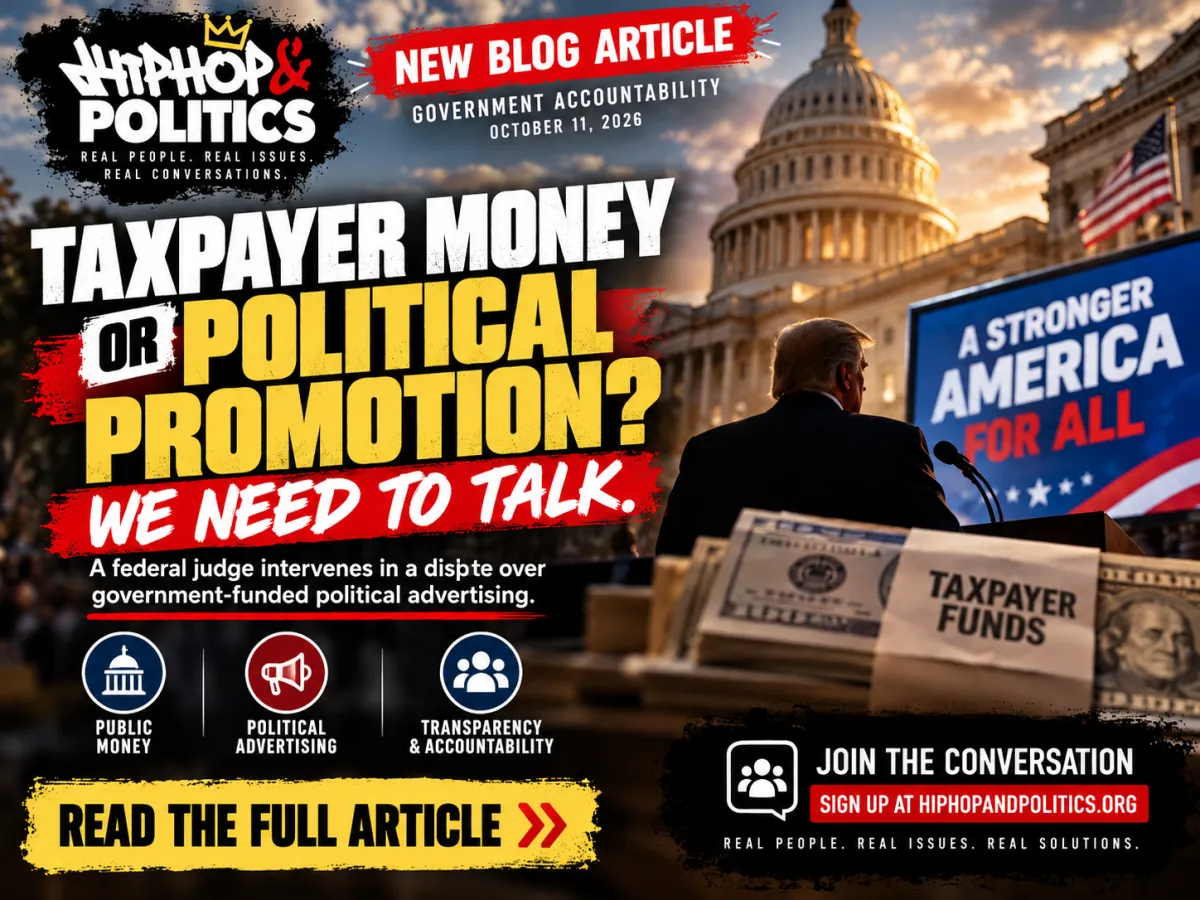
Taxpayer Money or Political Promotion? We Need to Talk.
Okay, America. We need to talk about something that should concern taxpayers regardless of political affiliation.
You know how people get when they find out their hard-earned money has been spent on something they never agreed to?
Well, imagine learning that taxpayer funds were used for television advertisements praising a sitting president just weeks before an election.
Now, whether you love that president, dislike that president, or are somewhere in between, the question deserves attention.
Where should government communication end and political promotion begin?
What happened this week?
On October 11, Reuters reported that U.S. District Judge Jennifer Rochon temporarily blocked the Trump administration from using taxpayer money to fund advertisements promoting President Donald Trump.
The decision followed a lawsuit brought by Common Cause and other plaintiffs who alleged that the government-funded advertisements were political propaganda intended to benefit Republican candidates ahead of the November 3 midterm elections.
The administration had already indicated plans to discontinue taxpayer funding for the advertisements. President Trump defended them as positive promotion of the United States, while the White House said his political action committee would fund the advertisements going forward.
According to Reuters, the White House also indicated that taxpayers would not be reimbursed for advertisements that had already aired.
The court's action was a temporary order, not a final determination of every legal issue raised in the case.
Why should ordinary Americans care?
Because public money belongs to the public.
It doesn't belong personally to a president, a governor, a mayor, a political party, or any elected official.
Government agencies absolutely have legitimate reasons to communicate with the public.
They may need to explain emergency programs, healthcare services, tax deadlines, disaster assistance, or changes in federal policy.
That's public information.
But when government-funded communication begins looking like an election advertisement, we have to examine its purpose.
And here's the part that shouldn't be controversial:
Standards for the use of public money should apply consistently, regardless of which political party controls the government.
If something would concern us under a Democratic administration, it should concern us under a Republican administration.
And vice versa.
Accountability cannot be something we only demand when the other team is in charge.
This is bigger than one president
We live in an era when political communication is everywhere.
Television advertisements. Social media videos. Influencers. Podcasts. Paid endorsements. Campaign emails.
And let's not forget those text messages that somehow find your phone number every election season.
Seriously, how did everybody get my number?
But behind the humor is a legitimate issue.
Political advertising influences how people understand candidates, policies, and elections.
The source of funding matters because it helps citizens distinguish government information from partisan persuasion.
When public resources and political messaging become difficult to separate, questions arise about fairness, transparency, and public trust.
What this means for local communities
This issue doesn't stop in Washington.
Think about your own city or county.
What happens when public officials use government newsletters, publicly funded events, or official communication channels to promote their personal political image?
Not every appearance by an elected official is inappropriate. Officials have legitimate duties to explain public programs and represent their offices.
But residents have every right to question whether public communications serve a genuine government purpose.
Consider the difference between a city informing residents about a new housing assistance program and using public funds to produce what effectively functions as a reelection commercial.
Those are not necessarily the same thing.
And understanding the difference helps protect the integrity of public institutions.
Our communities need accountability, not political fan clubs
Here's something I want us to get comfortable with.
You can support a political leader and still question their decisions.
You can appreciate a policy and still demand transparency.
You can vote for somebody and later disagree with them.
That doesn't make you disloyal.
That makes you an engaged citizen.
Our democracy was not designed to require unconditional agreement with elected officials.
Public service comes with public responsibility.
And citizens should never feel obligated to surrender their judgment in exchange for belonging to a political movement.
QueenDelilah's community challenge
This week, I want you to learn how your local government communicates with residents and how those communications are funded.
Visit your city or county website. Review public meeting agendas, budgets, or expenditure reports.
Find out whether your local government offers a public records request process and how residents can ask questions about spending.
Then attend a public meeting, watch a recording, or submit a thoughtful question to your elected representatives.
You don't have to become a political expert overnight.
But you do have to begin somewhere.
Because accountability is not an attack on government. It's one of the responsibilities of citizenship.
Join the conversation
Do you believe taxpayer-funded government advertisements should face stricter rules when elected officials appear in them?
Where should we draw the line between informing the public and promoting a political figure?
I want to hear your perspective, including perspectives that challenge mine.
Join the HipHop & Politics community at HipHopandPolitics.org, sign up, and share your thoughts.
We are building a community where people can ask difficult questions without being treated like enemies.
Because the goal is not to agree on everything.
The goal is to become better informed, more engaged, and more responsible participants in the future of our country.
Real People. Real Issues. Real Conversations.
And yes, we're going to ask where the money went.
Reporting referenced
Reuters, Luc Cohen, with additional reporting by Courtney Rozen, October 11, 2026: US judge orders halt to taxpayer-funded ads featuring Trump