THE BLUE WAVE OF 2026: BLACK POLITICAL POWER, HISTORIC VICTORIES, AND THE QUESTION AMERICA MUST ASK NEXT
From the Civil Rights Movement to a New Congressional Majority — What This Election Means for Democracy, Representation, and the American Economy
America Went to the Polls — And Changed the Political Landscape
Well, America, the ballots have been cast, the votes are being counted, and Washington is preparing for a different political reality.
The November 3, 2026 midterm elections delivered sweeping Democratic victories, with the party securing control of both the United States House of Representatives and Senate.
Democrats made gains in states that had traditionally favored Republicans, while voters expressed widespread frustration with rising living expenses, economic uncertainty, and the direction of the country.
For Democratic leaders, these results represent a major political opportunity. For Republicans, they create a new challenge in governing alongside an opposition-controlled Congress.
But for everyday Americans, the more important question is much simpler:
Will this political change make life more affordable?
Because while Washington celebrates victories and debates defeats, millions of Americans are still trying to figure out how to stretch their paychecks between groceries, housing, transportation, childcare, and healthcare.
And no, the electric company does not accept political promises as payment.
That is where our conversation begins.
The Black Vote: A History Written Through Struggle and Persistence
To understand the significance of the 2026 election, we have to understand the history of Black political participation in America.
There was a time when Black Americans were systematically prevented from exercising one of the most fundamental rights of citizenship: the right to vote.
Following the Civil War, the 15th Amendment prohibited denying voting rights on the basis of race. Yet poll taxes, literacy tests, intimidation, violence, and discriminatory election practices continued to disenfranchise Black communities, particularly throughout the South.
The Civil Rights Movement challenged these barriers through organizing, litigation, demonstrations, and extraordinary personal sacrifice.
The Voting Rights Act of 1965 became one of the movement's defining legislative achievements, strengthening federal protections against racial discrimination in voting.
It was not simply a political victory. It was a turning point in the struggle over who could participate in American democracy.
The history matters because political representation does not begin on Election Day.
It begins with access.
It continues through participation.
And it becomes meaningful when elected officials are held accountable for their decisions.
From 1965 to Barack Obama: The Evolution of Black Electoral Influence
Fast-forward to 2008.
The election of Barack Obama as America's first Black president marked a historic milestone in the nation's political development.
His election also demonstrated the significance of Black political participation within a broader, multiracial electoral coalition.
According to the U.S. Census Bureau, approximately 64.7% of eligible Black citizens voted in the 2008 presidential election.
In 2012, that figure increased to 66.2%, exceeding the 64.1% turnout recorded among eligible non-Hispanic White citizens.
For the first time in the Census Bureau's comparable series beginning in 1996, Black citizens voted at a higher rate than non-Hispanic White citizens.
Think about that historical progression.
From generations of exclusion and intimidation to record-setting political participation within a few decades.
That achievement deserves recognition.
But we must also remember that Black voter turnout has fluctuated in subsequent elections. The 2012 milestone does not establish that turnout has continued rising every election cycle.
And as of November 5, comprehensive national turnout figures for Black voters in the 2026 midterms are not yet available.
What we can examine today are the election outcomes and the new opportunities they create for representation.
2026: A Historic Moment for Black Political Representation
One of the most consequential stories emerging from this election is the election of Black leaders to offices that had never previously been held by Black Americans.
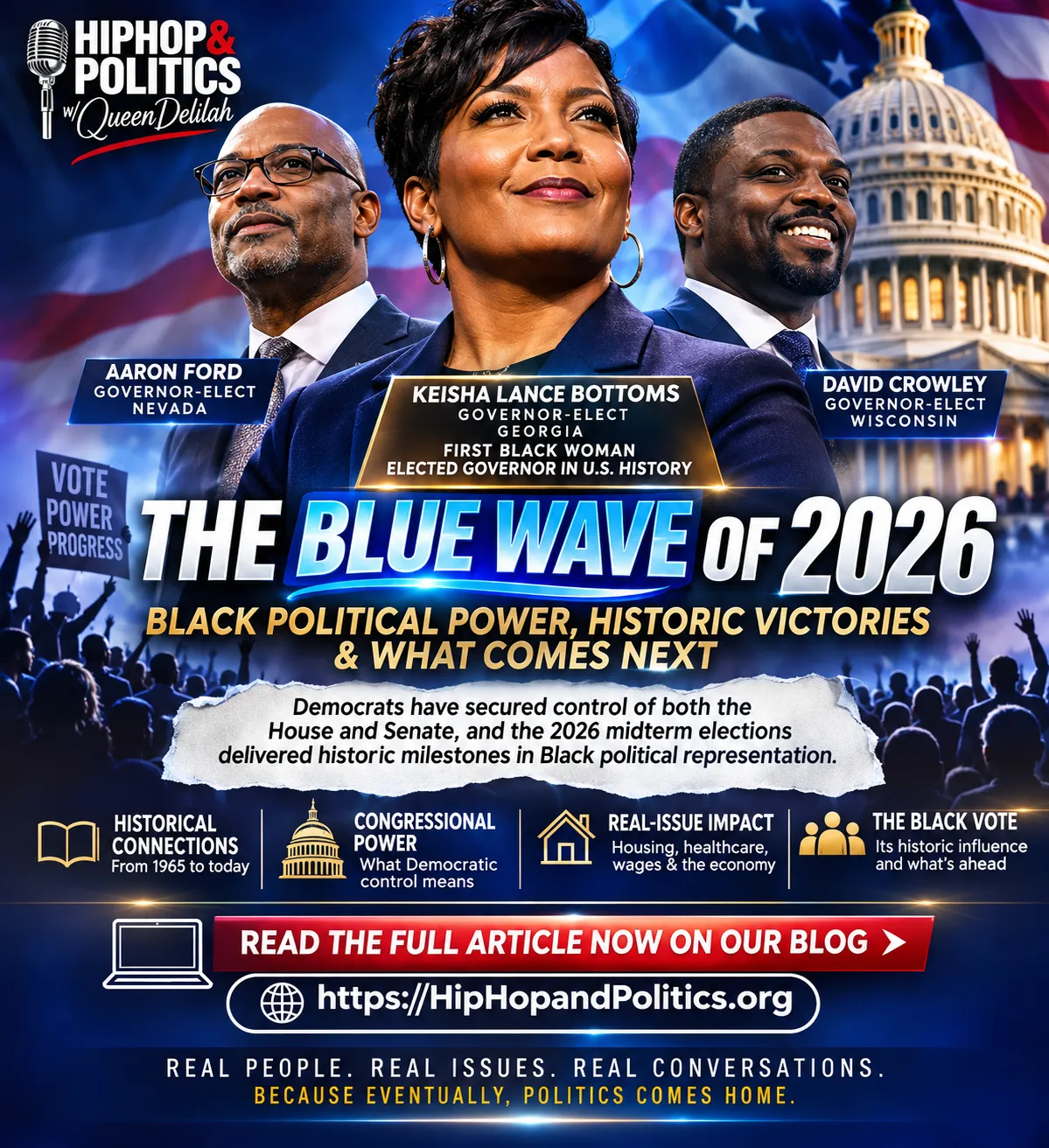
In Georgia, former Atlanta Mayor Keisha Lance Bottoms won the governorship, becoming the first Black woman elected governor of a U.S. state.
Her victory is particularly significant when viewed alongside the political organizing and voter-engagement efforts that reshaped Georgia over the past decade.
Stacey Abrams' gubernatorial campaigns in 2018 and 2022, although unsuccessful, helped bring national attention to voter registration, turnout, and political participation in Georgia.
The 2026 election also produced historic gubernatorial victories in Nevada and Wisconsin, including Aaron Ford's election as Nevada's first Black governor.
These developments expand the range of offices in which Black Americans are represented.
And representation matters.
A governor influences state budgets, public education, transportation, healthcare administration, housing priorities, and appointments to important government positions.
Those decisions can affect families for generations.
But we should be careful not to confuse individual milestones with universal progress.
Preliminary analysis from the Joint Center for Political and Economic Studies suggests that Black representation in the U.S. Senate could reach a record level, while Black representation in the House may actually decrease.
That is an important distinction.
History is being made, but the work of achieving representative government remains unfinished.
Democrats Have Won Congress. Now What?
The Democratic Party's victories in the House and Senate will significantly change the balance of power in Washington when the newly elected Congress convenes.
Control of the House provides Democrats with influence over legislative priorities, committee leadership, federal spending negotiations, and congressional investigations.
Control of the Senate provides additional influence over legislation, oversight, and the confirmation process for certain federal appointments.
Together, those powers create opportunities to advance policies Democrats have emphasized, including healthcare affordability, consumer protections, housing access, labor rights, and certain tax and social spending priorities.
However, there is a constitutional reality that cannot be ignored.
President Donald Trump remains in the White House.
A Democratic congressional majority does not automatically guarantee that Democratic legislation will become law.
Bills generally must pass both chambers and receive presidential approval, unless Congress can override a veto. Senate rules and political disagreements can also prevent proposals from advancing.
This means the next phase of American politics could involve intense negotiations, legislative compromises, investigations, and periods of gridlock.
The election has changed who controls Congress.
It has not eliminated the constitutional checks and balances governing federal policymaking.
What Does This Mean for the Everyday American?
Here is where I believe the national conversation needs to focus.
Political victories are important, but public policy should ultimately be evaluated by its effect on people's lives.
1. Housing Affordability and Homeownership
Across the country, households continue to face significant challenges involving home prices, rent, mortgage payments, insurance, and the cost of maintaining a property.
Democratic lawmakers have historically supported various approaches to affordable housing, including housing assistance, tax incentives, and investments intended to increase housing supply.
Whether Congress can agree on meaningful housing legislation remains uncertain.
And even if new legislation passes, housing affordability will still depend on factors such as interest rates, construction costs, local regulations, insurance markets, and available inventory.
For a family trying to purchase its first home, the important question is not simply which party proposed a housing policy.
It is whether that policy improves access to safe, sustainable, affordable housing.
2. Healthcare and Household Financial Security
Healthcare remains one of the largest financial concerns facing American families.
Democrats have generally emphasized protecting and expanding healthcare coverage, while Republicans have frequently advocated different approaches involving spending restraint, market competition, and regulatory changes.
The new Congress may revisit insurance affordability, federal healthcare funding, prescription drug costs, and consumer protections.
But any significant change will require navigating the legislative process and potential presidential opposition.
For working households, the consequences could affect insurance premiums, out-of-pocket expenses, and access to care.
3. Wages, Employment, and the Cost of Living
The economy played a major role in the 2026 election.
Voters expressed concern about inflation, household expenses, and their financial security.
Democratic lawmakers may seek to advance proposals involving worker protections, wages, taxation, and assistance for lower- and middle-income households.
Republican policymakers may continue advocating tax reductions, deregulation, and other policies they argue support investment and economic growth.
Both approaches involve tradeoffs that deserve careful examination.
And neither party can independently control every factor affecting prices.
Inflation, energy markets, international trade, Federal Reserve decisions, supply chains, and private-sector investment all influence the economic conditions Americans experience.
The test for elected officials will be whether their policies produce measurable improvements rather than simply persuasive political messaging.
The Black Economy: Representation Must Lead to Opportunity
Black political representation is important.
But we also need to discuss Black economic opportunity.
The racial wealth gap remains a major challenge in American society, reflecting historical inequalities involving property ownership, access to credit, education, employment, and inherited wealth.
For many Black families, building financial security means overcoming barriers that extend far beyond any single election.
That makes economic policy especially important.
Access to affordable housing, business financing, quality education, workforce development, and opportunities to build assets can influence whether families accumulate wealth across generations.
When Black leaders gain political influence, communities have an opportunity to ask specific questions about these issues.
What policies are being introduced to expand access to capital?
What investments are reaching underserved neighborhoods?
Are small businesses gaining meaningful opportunities?
Are public education and workforce programs producing better outcomes?
Are housing policies addressing longstanding disparities?
And perhaps most importantly, how will the public measure the results?
Those questions should be asked of elected officials regardless of political affiliation.
Why Black Voters Cannot Be Taken for Granted
Black voters have played an important role in Democratic electoral coalitions for decades.
That historical relationship deserves examination, but it should never be treated as unconditional.
Black Americans represent a diverse electorate with different economic priorities, political beliefs, religious perspectives, and views about government.
Some prioritize healthcare and education.
Others focus on entrepreneurship, public safety, taxes, housing, civil liberties, or economic independence.
Many care about several of these issues simultaneously.
Political parties must earn trust through their actions, not simply assume loyalty based on historical voting patterns.
And voters should expect clear explanations of policy proposals, public spending, legislative decisions, and measurable outcomes.
Democracy is not strengthened when citizens stop asking questions after their preferred candidates win.
It is strengthened when public accountability continues after Election Day.
A New Political Chapter, Not the End of the Story
The 2026 election will be remembered for a major shift in congressional power and historic breakthroughs in political representation.
It also arrives at a moment when Americans are deeply concerned about their financial futures and the direction of the country.
For Democrats, winning Congress creates an opportunity to demonstrate how their legislative priorities would address those concerns.
For Republicans, the election raises questions about the party's policy direction, electoral coalition, and approach to governing under divided government.
For Black Americans, the historic election of additional leaders creates opportunities to examine the relationship between representation, public policy, and economic progress.
But no election result should be mistaken for the completion of that work.
The Civil Rights Movement did not end with one law.
The struggle for representation did not end with one presidential election.
And the pursuit of economic opportunity will not end with one congressional majority.
Progress must be evaluated over time.
QueenDelilah's Closing Thoughts: Political Power Is a Responsibility
There is something powerful about looking back at American history and recognizing how much has changed.
The generations who marched for voting rights helped create opportunities that many Americans now exercise at the ballot box.
Today, Black Americans are winning elections to offices once closed to them.
That is a meaningful part of our national story.
But I want us to remember something.
Political power is not the finish line.
It is a responsibility.
The American people deserve more than campaign promises, political celebrations, and televised arguments.
They deserve government that can explain its decisions, justify its spending, protect constitutional rights, and demonstrate how public policy affects their everyday lives.
Whether you voted Democratic, Republican, independent, or supported another political movement, those expectations should remain the same.
Because at the end of the day, democracy belongs to the people.
And the people should never stop asking questions.
LET'S CONTINUE THE CONVERSATION
Do you believe the 2026 election results will lead to meaningful economic changes for working Americans?
What should the new congressional majority prioritize first: housing, healthcare, wages, education, or government accountability?
And how should communities measure whether greater political representation is producing meaningful progress?
Share your perspective and join the discussion at:
HipHop & Politics w/ QueenDelilah
Real People. Real Issues. Real Conversations.
Because Eventually, Politics Comes Home.
Sources and Further Reading
Associated Press — Calling Control of Congress in the 2026 Midterm Elections, November 5, 2026.
https://www.ap.org/the-definitive-source/behind-the-news/calling-control-of-congress-in-the-2026-midterm-elections/Reuters — Top Takeaways From the U.S. Midterm Elections, November 4, 2026.
https://www.reuters.com/business/media-telecom/takeaways-us-midterm-elections-2026-11-04/U.S. Census Bureau — Blacks Voted at a Higher Rate Than Whites in 2012 Election, May 8, 2013.
https://www.census.gov/newsroom/archives/2013-pr/cb13-84.htmlJoint Center for Political and Economic Studies — Black Representation in the 2026 Midterm Elections, November 4, 2026.
https://jointcenter.org/black-representation-in-the-2026-midterm-elections/The Guardian — Ten Historic Firsts: The Winning U.S. Midterm Candidates Making Waves, November 4, 2026.
https://www.theguardian.com/us-news/2026/nov/04/us-midterms-historic-firstsCBS News — Democrat Aaron Ford Wins 2026 Nevada Governor's Race, November 5, 2026.
https://www.cbsnews.com/news/2026-midterm-elections-nevada-governors-race-results-aaron-ford-joe-lombardo/Reuters — Keisha Lance Bottoms Wins Georgia Governor's Race, November 3, 2026.
https://www.investing.com/news/politics-news/keisha-lance-bottoms-wins-georgia-race-becomes-first-black-woman-elected-governor-of--us-state-4997155
Editorial note: This article reflects election reporting available as of November 5, 2026. Some individual race results, representation totals, and turnout figures remain subject to further updates.