THE DROP: WHEN THE MUSIC RISES FROM THE DAMAGE
There is something powerful about watching a community attempt to rebuild itself while still carrying the consequences of everything it has survived.
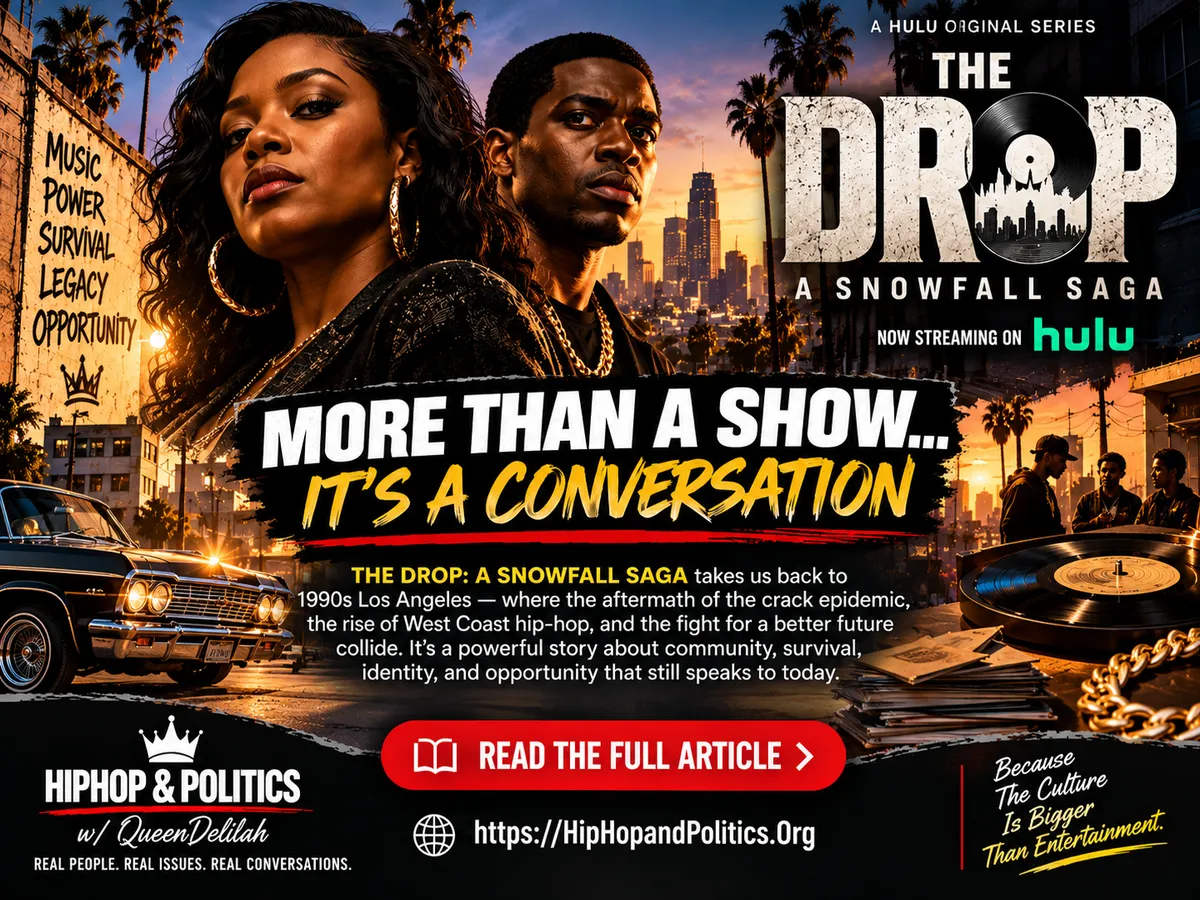
FX's The Drop: A Snowfall Saga, streaming on Hulu, takes us into 1990s Los Angeles, where the crack cocaine epidemic has left lasting scars and a new cultural movement is gaining momentum: West Coast hip-hop.
The series follows Wanda Bell and Leon Simmons, familiar faces from Snowfall, as they attempt to reinvent their lives. Wanda sees the emerging rap industry as an opportunity to build something meaningful, while Leon pursues a different form of redemption through community legal services.
But the path forward is complicated by street violence, family loyalties, commercial ambition, and the lingering consequences of addiction.
And that is where this story becomes much bigger than entertainment.
Because The Drop is not simply about the birth of a musical movement. It is about what happens when a community must create opportunities while still recovering from the conditions that limited them.
The Crack Epidemic Didn't End When the Headlines Changed
One of the most important connections between Snowfall and The Drop is the reality that the damage caused by the crack epidemic did not disappear when the drug crisis stopped dominating national headlines.
Families were fractured. Communities experienced violence, incarceration, addiction, and economic instability. Children grew up navigating the consequences of decisions and circumstances that preceded them.
The series uses fictional characters to explore that historical aftermath.
But the underlying issues are real.
Research has documented how punitive drug policies, concentrated poverty, and unequal access to treatment contributed to lasting consequences in many Black communities.
And those consequences did not affect every family or neighborhood in the same way.
When we discuss the struggles of the Black community, we must be careful not to reduce an extraordinarily diverse population to one story of hardship.
But we also cannot ignore the historical policies and economic conditions that shaped particular neighborhoods.
Hip-Hop Was More Than Music. It Was an Economic Opportunity.
There is another side to this story that deserves attention.
Hip-hop created opportunities for young people whose experiences were often overlooked by mainstream institutions.
Through music, production, promotion, fashion, and entrepreneurship, artists began turning their creativity into cultural and commercial influence.
In The Drop, Wanda recognizes that possibility.
She believes music can change lives, open doors, and build something that lasts.
But the series also raises an uncomfortable question:
Who gets to own the value created by Black culture?
The distinction between creating a cultural movement and controlling its economic rewards has shaped decades of debate about the music industry.
Artists may generate the creativity, identity, and audience loyalty that make a business successful while having limited ownership of their recordings, contracts, or distribution.
That is not unique to Black artists, but it carries particular historical significance in a music industry shaped by racial barriers and unequal bargaining power.
For me, that is one of the most compelling conversations this series invites.
We can celebrate the global influence of hip-hop while still asking whether the communities that helped build it have shared fairly in its financial success.
The Cycle of Survival Versus the Opportunity to Build Wealth
Wanda's ambition and Leon's desire to leave the streets behind reflect two different responses to a difficult environment.
One is trying to create an economic future through music.
The other is trying to repair damage and establish a different legacy.
Both approaches raise questions that remain relevant today.
What does financial opportunity look like when access to capital is limited?
How does someone rebuild after addiction, incarceration, or economic hardship?
What happens when young people have extraordinary talent but limited institutional support?
And how do communities create lasting wealth rather than simply generating income that leaves the neighborhood?
These are not questions a television series can answer by itself.
But they are questions that deserve public discussion.
When the Community's Pain Becomes Someone Else's Profit
One of the more difficult themes surrounding hip-hop's commercial rise is the relationship between authentic storytelling and the marketplace.
Music reflecting violence, poverty, and survival can give voice to lived experiences.
But commercial success can also create incentives to package those experiences in ways that are profitable, even when the people and communities represented receive limited benefits.
That tension is worth examining without dismissing the artistic freedom of the musicians themselves.
Black artists should not be expected to tell only uplifting stories.
Nor should they be reduced to the most painful experiences associated with their communities.
The deeper issue is whether artists have meaningful choices, fair compensation, creative control, and opportunities to build sustainable careers.
What The Drop Says About the Black Community Today
Although the series takes place in the 1990s, its themes extend into the present.
Many communities continue to debate access to affordable housing, business financing, educational opportunities, addiction treatment, criminal justice reform, and generational wealth.
At the same time, Black entrepreneurs, artists, professionals, educators, and community organizations continue to build institutions and opportunities that deserve recognition.
Both realities belong in the conversation.
The Black community is not defined solely by struggle.
But understanding historical struggle is essential to understanding why some disparities persist and what approaches might address them.
Final Thoughts: The Music Changed. The Questions Remain.
What makes The Drop particularly relevant to HipHop & Politics is its exploration of how culture, economics, and public policy intersect.
The series reminds us that hip-hop emerged from real communities, real experiences, and real historical conditions.
It became a vehicle for storytelling, identity, entrepreneurship, and cultural influence.
But its success also raises enduring questions about ownership, opportunity, accountability, and who benefits when a community's creativity becomes a global business.
So as we watch Wanda, Leon, and the next generation navigate their futures, perhaps we should ask ourselves:
How do we ensure that the next generation doesn't simply inherit the consequences of the past, but also gains the resources and opportunities to build something different?
That's a conversation worth having.
HipHop & Politics w/ QueenDelilah
Real People. Real Issues. Real Conversations.
Because Eventually, Politics Comes Home.