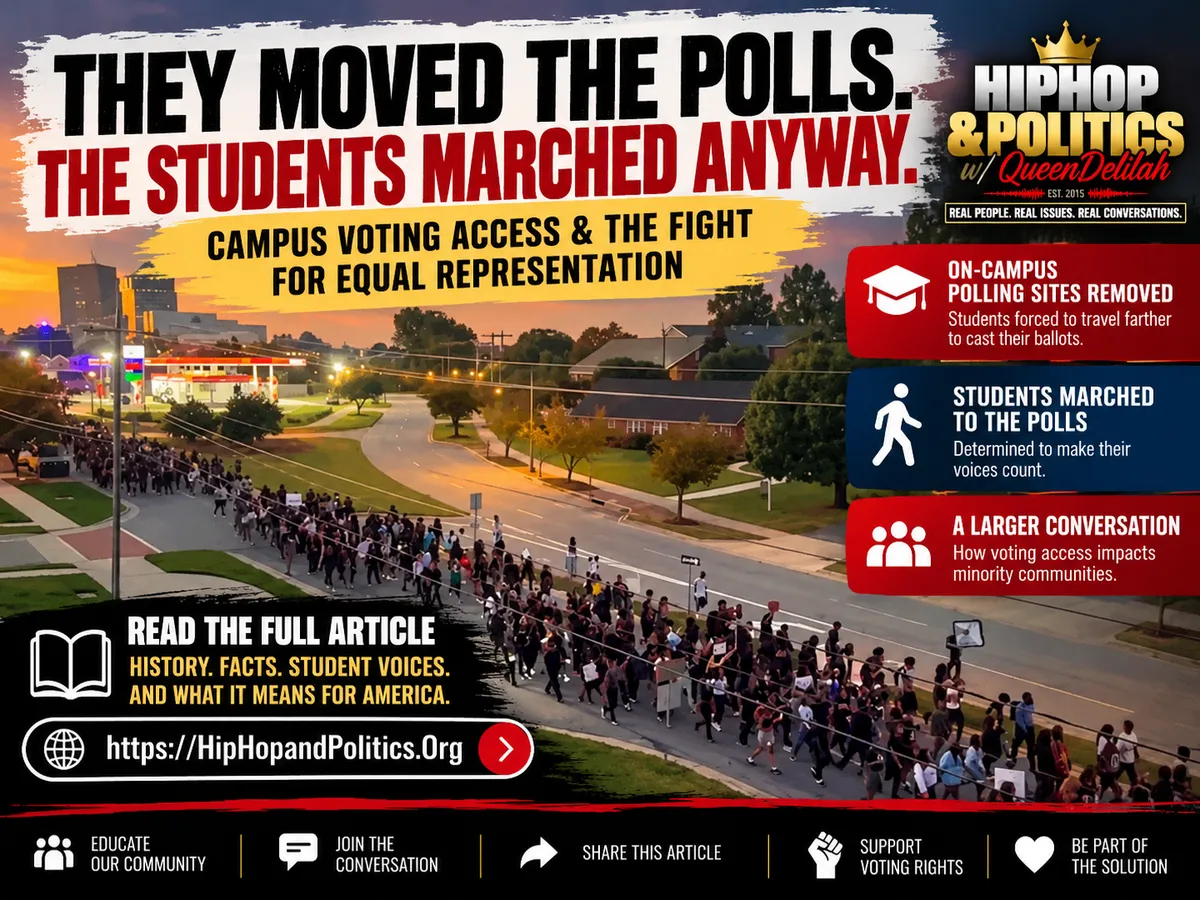
They Moved the Polls. The Students Marched Anyway.
North Carolina's campus voting controversy and the historical struggle over ballot access in Black communities.
By QueenDelilah | HipHop & Politics | October 17, 2026
On Thursday, October 15, students in Greensboro, North Carolina, did something that should make every American interested in voting rights pay attention.
They marched to vote.
Not because marching is a requirement of democracy. Not because a ballot should demand a demonstration of physical endurance. They marched because the early voting locations previously available on their college campuses were no longer part of the 2026 voting plan.
Students from North Carolina A&T State University and the University of North Carolina at Greensboro walked to the Union Square early voting location. Some North Carolina A&T students traveled approximately 45 minutes on foot, navigating uncomfortable heat, obstructed sidewalks, and stretches where pedestrians were forced into the street.
More than 100 students participated, according to local public-radio reporting. Other accounts described hundreds participating across the demonstrations.
And when they arrived? They still had to wait in line.
Now, I appreciate a good walk. But I don't believe casting a ballot should come with an unexpected fitness challenge.
The students' determination deserves attention. So does the decision that made their journey necessary.
What actually happened in North Carolina?
North Carolina A&T, the nation's largest historically Black university, and UNC Greensboro both hosted on-campus early voting locations during the 2024 general election.
For 2026, those sites were not approved. Students and voting-rights advocates appealed the decisions, but state election officials declined to restore the North Carolina A&T site.
There is an important factual distinction here: North Carolina A&T had an on-campus voting location in the 2024 presidential election, but it had not previously hosted one for a midterm election. So the dispute is about whether that established presidential-election access should have continued into 2026—not the closure of a polling place that had always operated during midterms.
Election officials have raised concerns about parking, site suitability, and election administration. Critics argue that the decisions prioritize drivers over students who walk, depend on public transportation, or do not own vehicles.
Those are competing explanations that deserve examination.
But whatever the intent, the practical consequence was visible: students who previously had a convenient campus location had to travel farther to cast their ballots.
Why the HBCU connection matters
North Carolina A&T is not just another college campus. It is a historically Black institution with a long tradition of civic engagement and student activism.
That history matters because the United States has an extensive record of election rules that placed disproportionate burdens on Black voters.
Poll taxes, literacy tests, discriminatory registration practices, intimidation, and unequal access to polling places were not abstract debates. They were documented tools used to restrict political participation.
Today's campus polling-site decisions are not legally or historically identical to those practices.
But they raise a related question: Can a voting rule appear neutral on paper while creating unequal barriers in practice?
Consider the student without a car. The student working between classes. The first-time voter unfamiliar with the city. The person with a disability who depends on a familiar and accessible location.
A change that looks minor on an election administrator's map may look very different from the sidewalk.
And the concern extends beyond Black students. Any policy that increases travel time or reduces voting opportunities can affect young voters, low-income residents, rural communities, older voters, and people with limited transportation.
This argument has appeared in North Carolina courts before
The historical connection is especially relevant because North Carolina has already been the subject of major federal voting-rights litigation.
In 2013, state lawmakers enacted legislation that changed voting rules, including reducing early voting opportunities and eliminating same-day registration.
In 2016, the U.S. Court of Appeals for the Fourth Circuit ruled against key provisions of that law. The court concluded that lawmakers had enacted restrictions with discriminatory intent and that the provisions targeted voting practices disproportionately used by Black residents.
That ruling does not establish that the 2026 campus decisions were discriminatory. Those decisions must be evaluated on their own records, explanations, and effects.
It does establish why concerns about unequal access in North Carolina are grounded in more than political rhetoric.
History gives the public a reason to ask careful questions. Evidence determines the answers.
From campus voting to “Souls to the Polls”
Another historical connection involves Sunday voting.
For years, Black churches and community organizations have coordinated “Souls to the Polls” initiatives, helping congregants participate in early voting after worship services.
During January 2026 proceedings, North Carolina election officials also rejected Sunday early voting hours in several counties.
Supporters of Sunday voting say those hours serve working people and communities that organize transportation through churches. Opponents have cited administrative preferences and concerns about Sunday voting.
The important issue is measurable access.
Who uses those voting opportunities? What alternatives remain? How far must voters travel? What happens to participation when hours or locations change?
These are questions election officials can answer with data—not merely assurances.
The difference between inconvenience and voter suppression
The phrase voter suppression carries serious historical and legal meaning.
In public debate, it often describes policies that discourage or obstruct eligible voters, particularly when burdens fall disproportionately on certain communities.
But not every polling-place relocation proves discriminatory intent, and an allegation of suppression is not the same as a court finding.
To evaluate the Greensboro decisions fairly, the public should examine the reasons officials gave, the alternatives they considered, transportation access, the number of voters served at the previous locations, and whether comparable communities were treated consistently.
That scrutiny is especially important when the affected population includes students at an HBCU.
The students' march demonstrates resilience. It does not, by itself, prove how many voters may have been discouraged from participating.
Both facts matter.
What should Americans take from this?
Voting rights are not measured solely by whether the law says someone may vote.
They are also shaped by whether eligible voters can realistically use the opportunities available to them.
An accessible election system requires more than ballots and machines. It requires thoughtful decisions about location, transportation, hours, disability access, staffing, and clear public information.
North Carolina's students demonstrated that they were willing to overcome an additional obstacle.
But citizens should not have to rely on extraordinary determination to exercise an ordinary constitutional right.
As we approach the November 3 election, I want readers to consider this:
When election officials change access to the ballot, what evidence should they be required to provide that the decision serves voters fairly?
That question belongs to every community, regardless of political affiliation.
Because voting rights aren't just about the people who make it to the polls.
They're also about understanding who faces greater difficulty getting there—and why.
Real People. Real Issues. Real Conversations.
Because Eventually, Politics Comes Home.
Visit https://HipHopandPolitics.Org to join the conversation.
Community discussion: Should election officials be required to conduct and publish a transportation and accessibility assessment before removing an established campus voting location?