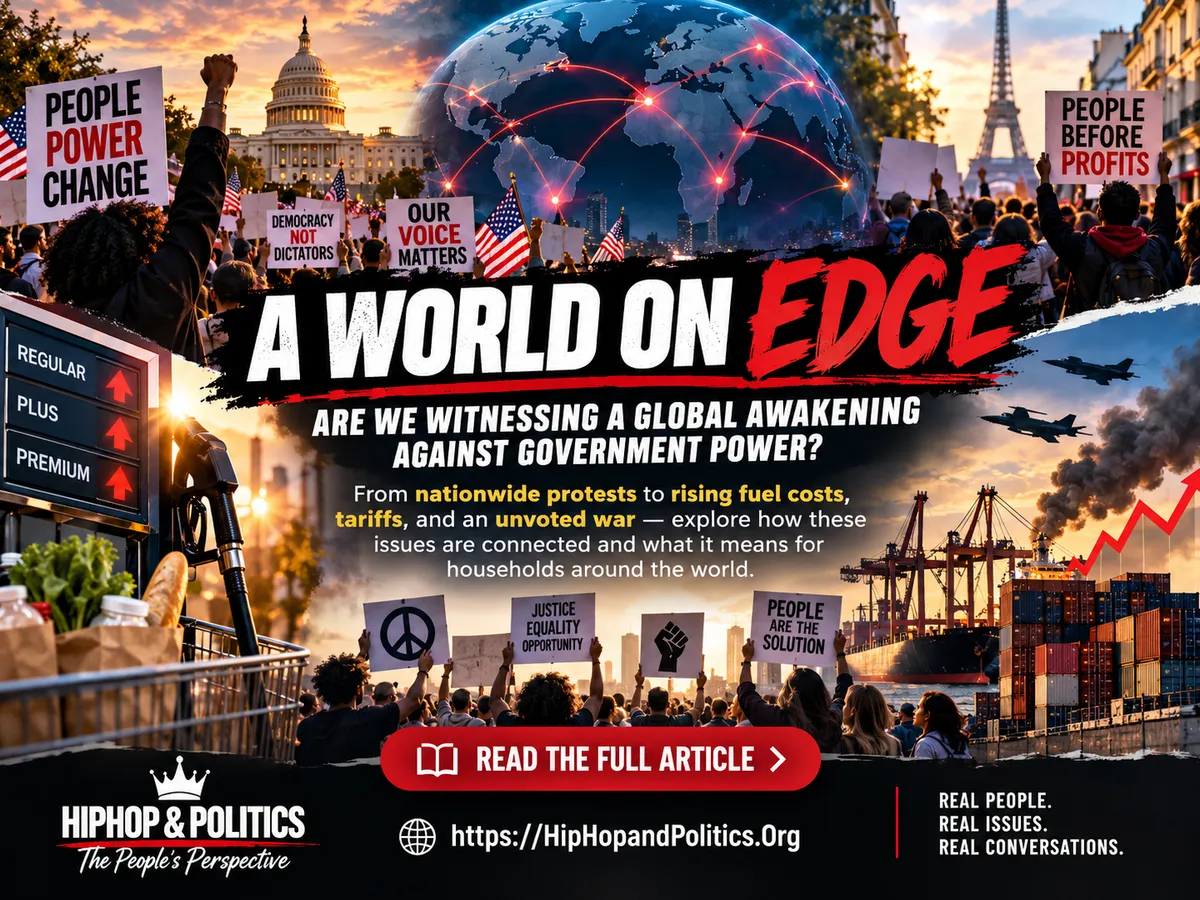
A WORLD ON EDGE: Are We Witnessing a Global Awakening Against Government Power?
From America's No Kings demonstrations to protests across Europe and Africa, citizens are questioning political power, rising living costs, war, and the price ordinary families are being asked to pay.
There is something happening in the world right now that deserves more than a passing headline.
People are taking to the streets.
Not just in America. Not just in countries experiencing political instability. We're witnessing demonstrations across democracies, developing economies, and nations where speaking against government authority can carry serious consequences.
And while these movements have different leaders, histories, and demands, many share a question:
Who is government actually working for when ordinary people are struggling to afford the necessities of life?
That question becomes even more urgent when decisions about military conflict, international trade, and economic policy travel across borders and eventually arrive at somebody's kitchen table.
Because here is something I have always believed: politics may begin in a government building, but eventually, it comes home.
1. America Takes to the Streets: The October 17 No Kings Demonstrations
On Saturday, October 17, 2026, demonstrators participated in the latest nationwide No Kings day of action.
Events took place across the United States, including New York, Washington, D.C., Atlanta, Houston, Connecticut, and California.
The demonstrations were organized by a movement opposing President Donald Trump's administration and what participants describe as the concentration of executive power. This latest mobilization emphasized voting access and early participation ahead of the November 3 midterm elections.
According to Associated Press reporting, demonstrators gathered near the Lincoln Memorial in Washington carrying signs focused on voting rights. In Atlanta, speakers encouraged residents to exercise their right to vote.
In Houston, participants also raised concerns about immigration enforcement, education, affordability, property taxes, and government accountability.
The protests were not exclusively about one policy. They reflected a broader collection of grievances about how political decisions affect everyday life.
That distinction matters.
A person concerned about immigration enforcement may have different priorities from a homeowner worried about property taxes. A student concerned about voting access may not share every opinion of a worker frustrated by rising prices.
Yet all can participate in the same demonstration.
This is one reason large civic movements can become significant: they bring different concerns into a common public conversation about accountability.
Sources:Associated Press, October 17; Click2Houston, October 17.
2. The Same Weekend, Europe Was Protesting the Cost of Living
Now, look across the Atlantic.
On October 17, demonstrations also took place in France, Belgium, Portugal, and Italy.
These were separate movements, not one internationally coordinated protest.
In France, hundreds of thousands demonstrated amid anger over economic conditions, education, and government policy. Some demonstrations escalated into violent clashes, property damage, and arrests.
In Portugal, protesters raised concerns about wages, housing affordability, and the cost of living.
In Belgium, students protested education costs and proposed reforms.
In Italy, demonstrations addressed war and economic hardship, although some gatherings also experienced serious confrontations with police.
There is an important distinction between peaceful protesters exercising democratic rights and individuals committing violence or destroying property. Both realities deserve accurate reporting.
But beyond the different national circumstances, one economic question keeps appearing:
Why does the cost of living continue to rise faster than many households can comfortably manage?
Consider what that means for a young adult in Lisbon who cannot afford rent, a student in Brussels worried about education costs, or a working family in Paris trying to balance groceries, utilities, and transportation.
Different countries. Different governments. Familiar pressures.
Source:Al Jazeera, October 17, 2026 — European cost-of-living protests.
3. Tunisia: When Economic Hardship Meets Political Freedom
The global picture extends beyond Europe.
On October 17, thousands marched in Tunis, Tunisia, protesting deteriorating living conditions and restrictions on political freedoms under President Kais Saied.
Participants included labor representatives, opposition groups, lawyers, journalists, and other members of civil society.
Their concerns included unemployment, rising prices, interruptions to basic services, and the detention of government critics.
Tunisia has experienced a particularly complicated political history since its 2011 uprising. President Saied argues that his consolidation of authority was necessary to address corruption and political dysfunction. Critics argue that the resulting changes weakened democratic institutions and civil liberties.
This is where economic concerns and political accountability intersect.
When people cannot reliably access essential services, their frustration may extend beyond prices to the institutions responsible for governing.
Source:Al Jazeera, October 17, 2026 — Tunisia protests.
4. America's War With Iran: Who Authorized It, and Who Pays for It?
Now we arrive at one of the most consequential international developments affecting household finances.
The U.S.–Iran war that began in February 2026 has disrupted energy markets and intensified debate over presidential war powers.
The constitutional question is substantial.
Under Article I of the U.S. Constitution, Congress holds the power to declare war. Presidents also exercise authority as commanders in chief, and administrations of both parties have historically asserted the ability to undertake certain military operations without a formal declaration of war.
Those competing interpretations have generated decades of legal and political disputes.
In September, the Senate rejected a resolution seeking to constrain President Trump's military operations against Iran. That vote should not be confused with Congress passing a formal declaration of war or a specific authorization for the conflict.
Supporters of the administration's approach argue that executive military authority and national-security considerations justify its actions. Critics argue that a prolonged conflict requires clearer congressional authorization and stronger legislative oversight.
Those are questions citizens are entitled to examine regardless of their political affiliation.
But constitutional authority is only part of the story.
The other part is economic.
When military conflict disrupts oil production, shipping, insurance, or transportation through strategically important waterways such as the Strait of Hormuz, the consequences can extend far beyond the countries involved in the fighting.
Fuel becomes more expensive. Shipping costs increase. Businesses face higher operating expenses.
And consumers may eventually pay more.
Sources:September 24 Senate war-powers reporting; The Guardian, October 8.
5. The Global Fuel Shock Is Real — And Developing Nations Are Especially Exposed
This is where the conversation becomes especially serious.
An October 11 report from the United Nations Development Programme examined how the Middle East conflict has affected developing economies.
Across 130 countries, the report found that average gasoline prices had increased 26% and diesel prices 38% since the conflict began.
Think about what those figures represent.
Diesel helps power freight transportation, agricultural machinery, commercial distribution, and essential supply chains.
When diesel becomes more expensive, it can cost more to transport food from farms to markets, deliver medicine, move construction materials, and operate businesses.
Countries that import much of their fuel can be especially vulnerable because they have less control over international energy prices.
And governments that attempt to protect consumers through fuel subsidies may face growing pressure on public budgets.
That can force difficult choices involving infrastructure, public services, borrowing, or taxation.
It would be inaccurate to claim that every shortage or price increase worldwide has one cause. Weather, domestic economic policy, exchange rates, existing debt, local conflicts, and supply-chain disruptions also matter.
But the UNDP's findings establish that the Middle East crisis is creating measurable economic pressure far beyond the battlefield.
Source:United Nations Development Programme, October 11, 2026 — No Time to Recover.
6. Tariffs: When Trade Policy Becomes a Household Expense
War is not the only international policy decision influencing prices.
Tariffs also deserve attention.
A tariff is a tax imposed on imported goods. Although foreign exporters may absorb some of the burden through lower prices, U.S. importers generally pay the tariff at the border, and part of that cost can be passed to American businesses and consumers.
The Trump administration has defended tariffs as tools for protecting domestic industries, encouraging manufacturing investment, generating revenue, and gaining leverage in trade negotiations.
Critics argue that broad tariffs can raise consumer prices, increase business costs, and provoke retaliation from trading partners.
Both the intended objectives and the actual economic effects should be evaluated using evidence.
A recent Institute on Taxation and Economic Policy analysis estimated that the administration's combined tax and cost policies increased the financial burden on typical households across most income groups. That is an organization's economic estimate, not an official measurement of every family's experience.
Tariffs can affect imported clothing, equipment, electronics, manufacturing inputs, and other goods. Their effects vary by product and supply chain.
Now combine trade-related costs with an international energy shock.
A business may face higher import costs while simultaneously paying more for freight and delivery.
Some of those increases can eventually reach consumers.
This is how international policy becomes personal.
Source:Institute on Taxation and Economic Policy, October 2026.
7. Is This a Global Awakening — or Several Crises Happening at Once?
I want to address the larger question carefully.
When demonstrations happen across multiple continents during the same week, it can feel as though the world is experiencing one collective political awakening.
There is a reasonable basis for seeing common themes: economic insecurity, frustration with public institutions, concerns about concentrated political power, and demands for greater accountability.
There are also genuine international connections.
Energy markets connect countries. Trade agreements connect economies. Wars affect migration, transportation, government budgets, and food supply chains.
Social media allows people to observe protests thousands of miles away and compare experiences in real time.
But shared grievances do not prove that governments are secretly coordinating their decisions, nor do simultaneous protests establish a single organized global movement.
To make that claim responsibly would require specific evidence of coordination.
What the reporting does show is that many communities are independently confronting similar questions about economic opportunity, political representation, and the responsibilities of government.
That may be the more important observation.
A global awakening does not have to mean everyone is following the same organizers or embracing the same ideology.
It can describe a period when people in very different societies begin asking comparable questions about power, fairness, and their futures.
8. Corruption, Accountability, and the Danger of Confusing the Two
There is another distinction we cannot afford to ignore.
Not every unpopular government decision is corruption.
A government may adopt a policy that produces harmful economic consequences without officials engaging in bribery, fraud, or personal enrichment.
Likewise, a decision can be lawful and still deserve public criticism.
Actual corruption requires evidence of misconduct, such as abuse of public office for private benefit, bribery, embezzlement, or improper favoritism.
Accountability is broader.
It asks whether leaders have acted transparently, complied with legal requirements, considered the public consequences of their decisions, and responded to legitimate concerns.
This distinction strengthens public debate.
We should investigate credible allegations of corruption rigorously while also examining policies that may be legal but economically damaging.
Citizens do not need to prove a conspiracy to question a decision that affects their lives.
9. What Does All of This Mean for American Households?
Let's bring this conversation home.
Imagine a household with two working adults, children, a mortgage or rent payment, car insurance, utilities, and groceries.
Their income may not have changed significantly.
But their fuel costs have increased. Their grocery bill is higher. Their insurance renewal is approaching. Their employer is experiencing higher transportation expenses.
Perhaps they own a small business that imports merchandise.
Perhaps one spouse works in construction, where materials and transportation costs matter.
Perhaps they are hoping to purchase their first home but are already struggling to save.
For these households, international policy is not abstract.
It can affect whether they save, borrow, invest, move, expand a business, or simply manage another month of expenses.
The same is true internationally, often with even fewer financial protections available.
This is why discussions about war, tariffs, inflation, housing, and public accountability belong in the same conversation.
They are not identical issues.
But they can interact in ways that compound pressure on ordinary people.
10. The Questions We Should Be Asking
I believe meaningful civic engagement begins with informed questions, not assumptions.
When reviewing these developments, consider:
What legal authority supports a military operation, and what oversight has Congress exercised?
Which economic effects are directly measured, and which remain forecasts or estimates?
Who pays tariffs in practice, and how are costs distributed?
What evidence supports allegations of corruption or abuse of power?
How are public officials addressing the cost of essential goods, housing, and transportation?
What specific demands are protesters making, and how have governments responded?
These questions matter whether someone supports or opposes a particular administration.
Government accountability should not depend on which political party holds office.
Final Thoughts: The World Is Connected, and So Are the Consequences
What happened across America and parts of the world this past week deserves our attention.
In the United States, demonstrators emphasized voting rights and political accountability.
In Europe, many protested the cost of living, housing pressures, and education policies.
In Tunisia, economic hardship and concerns about political freedom brought thousands into the streets.
Meanwhile, the U.S.–Iran conflict continues to affect international energy markets, and trade policies remain a source of economic debate.
These developments are not proof of one worldwide conspiracy.
They are evidence that political decisions, economic pressures, and public expectations are increasingly difficult to separate.
And perhaps the most useful question is not whether the world has awakened all at once.
Perhaps it is whether governments and the people they serve are having the same conversation about what security, prosperity, and accountability should actually mean.
Because a nation's strength cannot be understood through military capability or economic statistics alone.
It must also be examined through the lived experiences of its people.
Can they afford housing? Can they access essential services? Can they participate meaningfully in government? Can they question authority without fear?
Those are questions worth asking in every country.
And they're conversations worth having together.
Join the Conversation
At HipHop & Politics, we connect the headlines to the everyday realities of the people living through them.
What concerns you most about the relationship between international conflict, economic policy, and the rising cost of living?
What questions should public officials be answering?
Share your perspective and join our community at:
Real People. Real Issues. Real Conversations.
Because Eventually, Politics Comes Home.