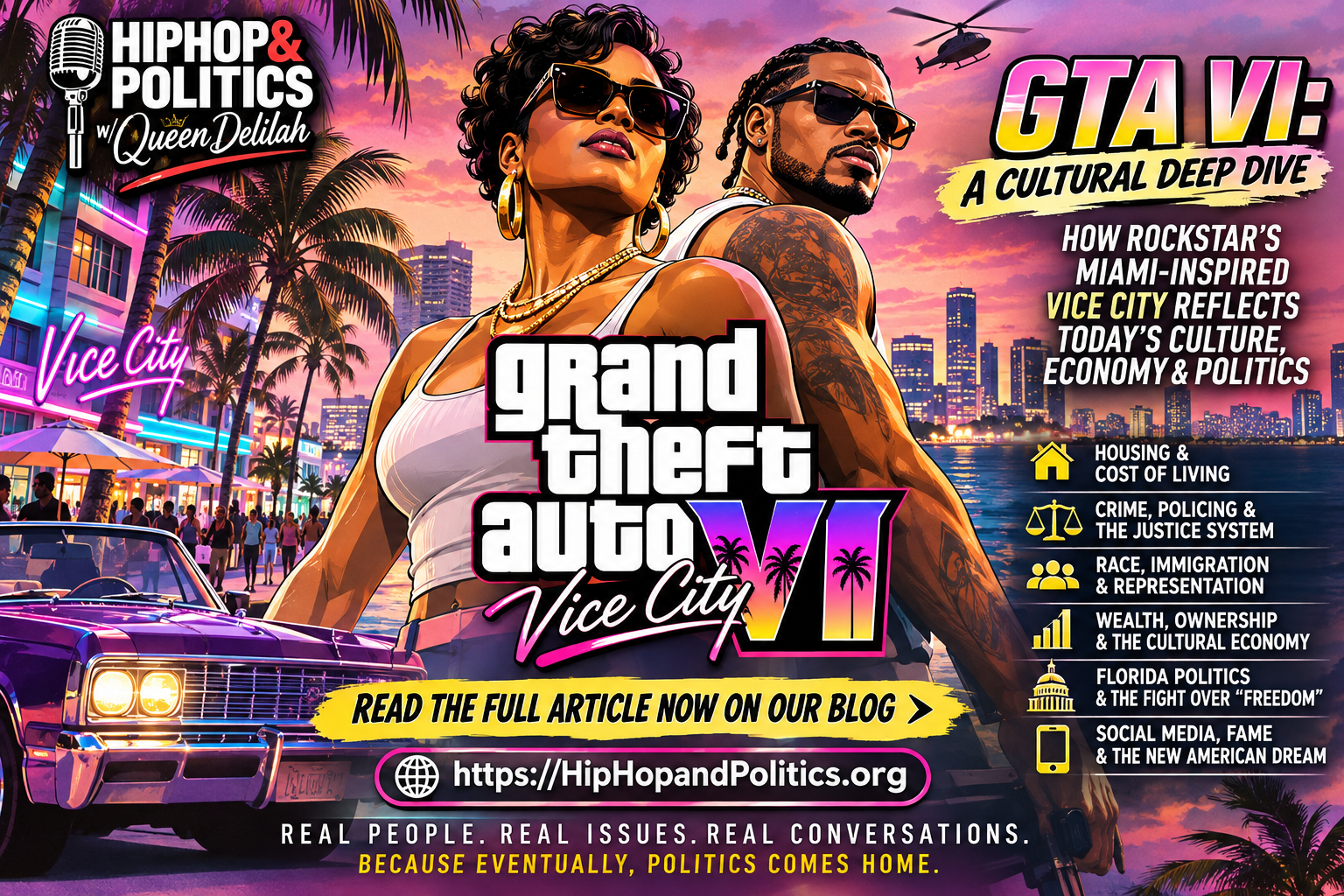
GTA VI: VICE CITY, REAL AMERICA — HOW ROCKSTAR TURNED MIAMI INTO A REFLECTION OF OUR CULTURE AND POLITICS
Behind the neon lights, luxury cars, hip-hop, and criminal empire lies a conversation about the American Dream, inequality, political power, and the price of becoming famous.
Welcome Back to Vice City. But America Has Changed.
Miami has always been a city of contrasts.
Luxury waterfront mansions stand within miles of working-class neighborhoods. International wealth flows through its real estate market while everyday residents confront the rising costs of housing, insurance, transportation, and basic necessities.
It's a city where music, fashion, immigration, tourism, entrepreneurship, and politics intersect.
And now, Rockstar Games has brought that world back to the center of popular culture through Grand Theft Auto VI.
But the Miami-inspired Vice City we remember from 2002 is not the Vice City of 2026.
The original Grand Theft Auto: Vice City drew heavily from the 1980s: cocaine trafficking, organized crime, neon-colored excess, celebrity lifestyles, and the pursuit of wealth at almost any cost.
The new game brings that formula into a different America.
An America where people can become famous overnight by recording themselves doing something outrageous.
Where political arguments unfold on social media before facts have been established.
Where luxury lifestyles are constantly advertised to people struggling to afford ordinary necessities.
And where the boundary between entertainment and reality becomes increasingly difficult to recognize.
That is what makes GTA VI culturally significant.
It is not just a fictional crime story.
It is satire built around the contradictions of modern American life.
1. Miami: The American Dream and the Cost of Living
Miami represents opportunity to people around the world.
It is an international destination for tourism, finance, entertainment, immigration, and real estate investment.
But behind the luxury image is a different economic reality.
Miami-Dade residents face serious affordability challenges, particularly when housing expenses are compared with local incomes.
That contrast is central to understanding why Vice City works so effectively as a setting.
In Rockstar's fictional world, expensive cars, waterfront properties, exclusive nightclubs, and visible wealth form the backdrop for people pursuing money through increasingly dangerous circumstances.
In the real world, wealth inequality raises important questions about access to opportunity.
Who gets to participate in Miami's economic growth?
Who owns the businesses, properties, and cultural attractions that make the city desirable?
And what happens to longtime residents when neighborhoods become increasingly expensive?
These are not questions that a video game can answer.
But the fictional setting provides an opportunity to discuss them.
GTA VI presents the fantasy of unlimited wealth. Miami's real housing market reminds us that even financial stability can be difficult to achieve.
And that is a cultural contradiction worth examining.
2. From Scarface to GTA VI: America's Fascination With Criminal Wealth
Miami's place in American entertainment history extends far beyond video games.
The 1983 film Scarface helped establish an enduring fictional image of Miami as a place where ambition, violence, luxury, and organized crime collide.
The television series Miami Vice reinforced the city's association with nightlife, fashion, drug trafficking, and glamorous excess.
Grand Theft Auto: Vice City later transformed many of those cultural influences into an interactive world.
GTA VI continues that tradition, but the meaning of the American Dream has evolved.
In earlier crime narratives, characters frequently pursued wealth through control of illegal businesses and territory.
Today, wealth is also associated with digital influence, personal branding, celebrity access, and viral visibility.
The desire to become successful remains familiar.
What has changed is how success is displayed.
Social media allows people to broadcast expensive purchases, exclusive vacations, and curated lifestyles to millions of viewers.
And sometimes, the performance of wealth becomes almost as important as possessing it.
GTA's satire invites us to question that culture.
When society constantly celebrates money, fame, and status, how do we distinguish ambition from exploitation?
And when criminal characters become cultural icons, what does that say about the stories Americans find entertaining?
3. Hip-Hop, Miami Bass, and the Cultural Economy
You cannot seriously examine Miami without discussing its influence on music.
Miami's musical identity has been shaped by African American, Caribbean, and Latin communities.
Miami bass helped define a distinctive sound through artists and groups such as 2 Live Crew, whose music became central to national debates about obscenity, censorship, and freedom of expression.
Those controversies were not simply about explicit lyrics.
They involved questions about who determines acceptable artistic expression and how government authority intersects with popular culture.
The broader Miami music scene also helped establish South Florida as an influential center for hip-hop, Latin music, dance, and nightlife.
Today, music is an essential part of the Grand Theft Auto franchise's identity.
GTA VI expands that connection through a wide selection of in-game radio genres, including modern hip-hop, Latin music, pop, dance, and electronic music.
Rockstar has also introduced on-demand podcasts within the game's fictional media environment.
That development is particularly interesting.
The game is not merely incorporating music into its world. It is recreating the broader media ecosystem that shapes how people understand culture.
And this raises an important economic question.
Who benefits when a global entertainment franchise draws inspiration from local music and culture?
Artists can gain exposure, licensing income, and new audiences.
But cultural visibility does not automatically guarantee ownership or long-term economic opportunity.
That distinction matters, especially when discussing Black cultural contributions to billion-dollar entertainment industries.
4. Social Media Has Turned Everyday Life Into Entertainment
One of the defining characteristics of GTA VI's promotional material is its depiction of viral videos, outrageous public behavior, and social media culture.
Rockstar appears to be using the digital age as a major source of satire.
And why wouldn't it?
We live in a country where a confrontation in a grocery store can become a national debate.
Where someone can gain millions of views for behaving recklessly in public.
Where political statements are edited into short clips designed to provoke immediate emotional reactions.
And where misinformation can spread faster than the corrections that follow.
The game exaggerates these behaviors for entertainment.
But its inspiration is recognizable.
The political implications are significant.
Social media platforms influence which issues receive public attention, how political controversies develop, and which voices gain visibility.
Algorithms frequently reward engagement, although engagement does not necessarily reflect accuracy or public importance.
This creates a difficult environment for journalism, civic education, and democratic discussion.
The question becomes:
Are Americans becoming better informed, or simply more entertained by conflict?
That is where GTA VI's cultural satire intersects directly with politics.
5. Florida Politics: Freedom, Regulation, and Contradiction
Florida has become a major center of national political debate.
Discussions surrounding education, immigration, public safety, reproductive rights, LGBTQ rights, environmental protection, and government regulation have frequently placed the state in the national spotlight.
Those issues are serious, and reasonable people disagree about the proper role of government.
GTA VI's fictional Leonida, meanwhile, appears designed to exaggerate elements of Florida's recognizable public identity.
The trailers and promotional material feature eccentric characters, conspicuous consumption, criminal activity, and outrageous behavior.
This creates a useful contrast.
Florida is frequently marketed as a place of freedom, recreation, opportunity, and personal independence.
Yet the meaning of freedom itself remains contested.
Does freedom mean fewer government restrictions?
Does it mean stronger protection of individual rights?
Does it mean economic opportunity?
Or does it require balancing individual choice with public safety and community welfare?
Different political philosophies offer different answers.
Rockstar's fictional world creates space to examine these tensions without treating its exaggerated characters as accurate representations of Florida residents.
The real state is far more diverse and complex than any video game portrayal.
6. Race, Immigration, and the Communities Behind Miami's Image
Miami's cultural identity is inseparable from immigration and the contributions of Black and Latino communities.
Cuban, Haitian, Jamaican, Bahamian, Dominican, Colombian, Venezuelan, and many other communities have influenced the region's food, language, music, entrepreneurship, and neighborhoods.
African American communities have also played foundational roles in Miami's history, including the development of Overtown, Liberty City, and other historically significant neighborhoods.
These communities are not merely decorative elements of Miami's identity.
They are central to its history and economic development.
Yet the entertainment industry's portrayal of culturally diverse cities raises important questions about representation.
Are communities shown as complex places with families, businesses, histories, and aspirations?
Or are they reduced to stereotypes involving crime, poverty, and exotic entertainment?
GTA VI is an adult-oriented satirical work, not a documentary.
Its purpose is not to provide a comprehensive portrait of Miami.
Still, audiences can enjoy fictional entertainment while critically examining the cultural narratives it reinforces.
Representation matters because popular entertainment can influence how people imagine places they have never visited.
7. Lucia Caminos: Gender, Crime, and the Changing Face of GTA
Lucia Caminos is one of the most significant additions to GTA VI.
As a central female protagonist, she represents a notable shift in a franchise historically dominated by male lead characters.
Her story involves incarceration, family aspirations, and a partnership with Jason Duval.
Rockstar's official description presents Lucia as someone determined to pursue a better life after difficult experiences.
That narrative opens several cultural discussions.
How are women represented in crime fiction?
Are female characters given the same complexity and agency as male protagonists?
How do poverty, family obligations, and limited economic opportunities influence the choices people make?
And how does entertainment portray people returning to society after incarceration?
These questions connect to real policy discussions about rehabilitation, reentry programs, employment barriers, and the consequences of criminal records.
The fictional character should not be treated as evidence about real-world criminal justice outcomes.
But her story provides a starting point for examining those issues.
8. Crime, Policing, and the American Justice System
Grand Theft Auto has always built much of its gameplay around criminal activity and conflict with law enforcement.
That formula raises broader questions about how Americans understand crime and policing.
In the real world, criminal justice policy involves competing priorities.
Communities want protection from violence and property crime.
They also want accountability, constitutional policing, and fair treatment under the law.
Those goals need not be mutually exclusive, although disagreements often arise over how to achieve them.
For Black Americans and other communities that have experienced discriminatory policing, discussions about enforcement and accountability can carry particular historical significance.
Meanwhile, communities affected by violence also have legitimate concerns about public safety and access to justice.
A serious conversation should recognize both realities.
GTA VI is entertainment, and its exaggerated gameplay should not be mistaken for a realistic account of police conduct or crime.
But its popularity offers an opportunity to ask why criminal justice remains such a powerful subject in American storytelling.
9. Climate Change: The Reality Behind the Tropical Paradise
Miami's geography makes it especially relevant to discussions about climate risk.
The region faces challenges involving sea-level rise, tidal flooding, extreme rainfall, hurricanes, and infrastructure resilience.
These issues affect more than environmental policy.
They influence property insurance, housing expenses, transportation, public budgets, and long-term investment decisions.
A waterfront property may symbolize luxury in a video game.
In real life, coastal property ownership also involves evaluating flood exposure, insurance availability, maintenance costs, and potential storm damage.
The relationship between climate risk and economic opportunity is particularly important for working-class households.
Wealthier property owners may have greater financial flexibility to absorb rising costs or relocate.
Lower-income residents may have fewer options.
That is why climate adaptation is not only an environmental issue.
It is also a housing and economic policy issue.
10. Rockstar Games and the Business of Selling American Culture
GTA VI is more than a creative product.
It is a major commercial release from one of the world's most recognizable entertainment franchises.
Its significance extends into music licensing, digital distribution, merchandising, marketing, streaming, and the broader gaming economy.
The game also arrives at a time when the video game industry is increasingly connected to film, television, music, social media, and professional content creation.
That convergence creates opportunities for artists, developers, designers, performers, and independent creators.
But it also raises questions about the concentration of intellectual property and economic power.
Who owns the characters and stories?
Who controls distribution?
How are creative workers compensated?
And how much economic value returns to the communities whose cultural identities inspire commercially successful entertainment?
Those questions are particularly relevant to hip-hop.
For decades, artists have debated ownership of masters, publishing rights, contracts, and the long-term value of creative work.
The same principle applies across entertainment industries.
Cultural influence is valuable.
Ownership determines who controls much of that value.
11. Miami Becomes Vice City — And Vice City Becomes Miami's Marketing Opportunity
The relationship between the fictional and real cities has become more than cultural inspiration.
Local reporting describes GTA VI-related promotional activity across Miami, including partnerships involving the Miami Heat, Wynwood Walls, and branded installations.
These efforts illustrate how a fictional entertainment property can become a real-world marketing asset.
For tourism businesses, retailers, artists, and entertainment venues, that attention may create commercial opportunities.
But the economic benefits are not automatically distributed throughout the community.
A large marketing campaign can generate visibility without necessarily solving local affordability problems or creating lasting economic improvements.
The more useful question is whether partnerships produce meaningful benefits for local businesses, artists, workers, and residents.
That is how entertainment economics connects to community development.
12. The Bigger Question: Is GTA VI Satirizing America, or Has America Become GTA?
Perhaps the most provocative aspect of GTA VI is how familiar its fictional world feels.
Outrageous public behavior.
Luxury lifestyles promoted as everyday reality.
A constant chase for money.
Political controversy transformed into entertainment.
Digital fame built around spectacle.
And ordinary people trying to survive in a system where success can seem increasingly difficult to reach.
Rockstar exaggerates these themes.
But exaggeration works best when audiences recognize the underlying reality.
That is the power of satire.
It allows creators to expose contradictions through humor, absurdity, and fictional storytelling.
Of course, a video game cannot explain every social problem, and players will experience GTA VI differently.
Some will enjoy the gameplay, characters, music, and open world without interpreting it as political commentary.
Others will see a reflection of economic inequality, celebrity culture, digital media, and American institutions.
Both experiences can coexist.
Entertainment does not need to become a political lecture to carry cultural meaning.
Sometimes the most revealing commentary comes from the stories people choose to tell for fun.
QueenDelilah's Closing Perspective: Behind the Neon Lights Is a Real America
GTA VI invites millions of people into a fictional version of Miami.
A place of ambition, entertainment, crime, luxury, and excess.
But behind the palm trees and expensive cars are themes that deserve serious consideration.
The pursuit of wealth.
The influence of social media.
The relationship between culture and ownership.
The challenges of affordability.
The role of government.
And the question of who gets to participate in the American Dream.
Miami is an appropriate setting for these conversations because its real history reflects extraordinary cultural creativity alongside complicated economic and political realities.
I believe that is what makes this release particularly interesting.
We can appreciate Rockstar's creativity while examining the society that inspired it.
We can enjoy hip-hop's influence on the soundtrack while discussing the economics of cultural ownership.
And we can recognize the absurdity of fictional Vice City while asking difficult questions about real American life.
Because sometimes, understanding a culture requires examining what it chooses to celebrate, criticize, and turn into entertainment.
GTA VI may be a video game.
But the America it reflects is worth talking about.
LET'S TALK
Does Grand Theft Auto VI accurately capture the culture of modern America, or does it exaggerate our worst behaviors for entertainment?
Is Miami the perfect setting for a story about wealth, fame, crime, and political contradictions?
And when entertainment companies profit from the culture of real communities, how should those communities benefit?
Join the conversation.
HipHop & Politics w/ QueenDelilah
Real People. Real Issues. Real Conversations.
Because Eventually, Politics Comes Home.
Research Sources
Rockstar Games — Grand Theft Auto VI official announcements and launch trailer: https://www.rockstargames.com/VI
PlayStation Blog — Grand Theft Auto VI Launches Tomorrow, November 19: https://blog.playstation.com/2026/11/18/grand-theft-auto-vi-launches-tomorrow-november-19/
The Miami Guide — GTA VI in Miami, local promotional activity and partnerships: https://themiamiguide.com/gta-6-miami/
U.S. Census Bureau — https://www.census.gov
National Oceanic and Atmospheric Administration — https://www.noaa.gov
Miami-Dade County — https://www.miamidade.gov
Editorial note: Interpretations of the game's political and cultural themes are commentary. Real-world socioeconomic and historical comparisons are not claims that Rockstar has endorsed any particular political position.