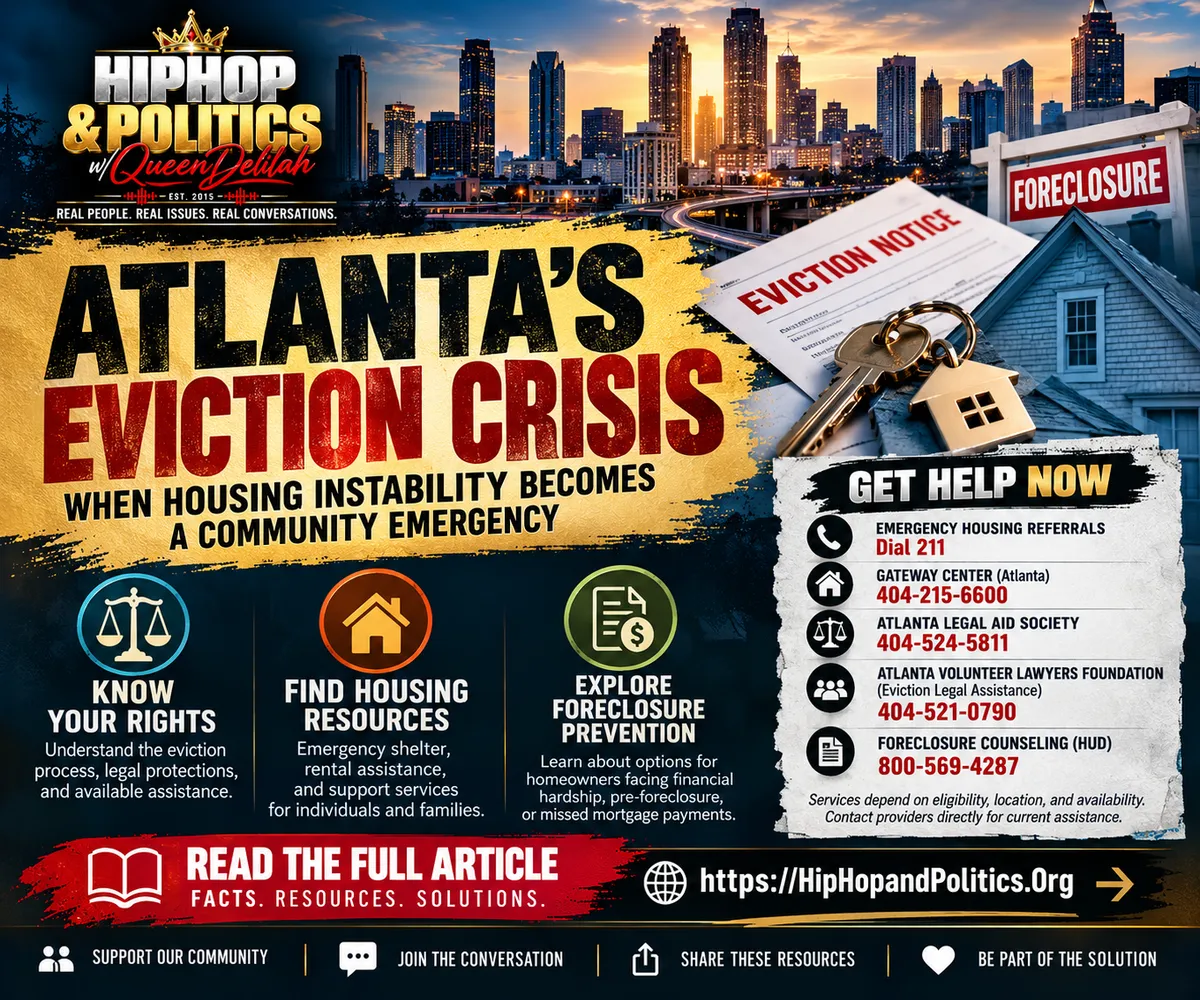
ATLANTA'S EVICTION CRISIS: WHEN HOUSING INSTABILITY BECOMES A COMMUNITY EMERGENCY
Atlanta Has a Housing Problem We Can No Longer Ignore
Atlanta has long represented opportunity.
A growing business community. A strong cultural identity. Educational institutions. Entrepreneurship. Economic development.
For generations, people have looked to Atlanta as a place where they could build careers, raise families, purchase homes, and establish financial independence.
But behind the skyline and economic development announcements, another reality is unfolding.
Metro Atlanta has become one of the nation's most troubling examples of housing instability.
According to Princeton University's Eviction Lab, approximately 142,000 eviction cases were filed across the five-county metro Atlanta region during a recent 12-month period.
That represents roughly 24 filings for every 100 renter households—approximately three times the national comparison rate.
Let me emphasize something important: an eviction filing is not the same as a completed eviction. Some cases are dismissed, resolved, or involve repeat filings against the same household.
But even with that distinction, the numbers are deeply concerning.
Because behind every court filing is a household facing the possibility of losing its housing.
And when housing becomes unstable, nearly every other part of life can become unstable with it.
Who Is Being Affected?
The crisis is not affecting every community equally.
Eviction Lab research reported in October 2026 found that Black residents represented approximately 69% of eviction cases in the region while accounting for roughly 53% of renters.
That disparity deserves serious examination.
It raises questions about income inequality, housing access, landlord practices, neighborhood investment, and the effectiveness of existing protections.
But this is not exclusively a Black housing issue.
It is an American housing issue with particularly severe consequences for certain communities.
Housing instability affects working parents, seniors, individuals with disabilities, veterans, young adults, and families trying to recover from unexpected financial setbacks.
And while these circumstances may differ, the central challenge remains the same.
A household cannot build long-term financial stability when it is constantly at risk of losing its home.
When the Paycheck No Longer Covers the Cost of Living
Consider a working household earning enough to cover its rent under ordinary circumstances.
Now introduce an unexpected expense.
A vehicle repair.
A medical bill.
A reduction in work hours.
An insurance increase.
Or an interruption in childcare.
Suddenly, the household is choosing which obligation gets paid first.
And when rent becomes late, the consequences can escalate quickly.
This is where the conversation becomes more complicated than simply telling people to budget better.
Financial discipline matters. Personal responsibility matters.
But neither eliminates the impact of insufficient affordable housing, rising essential expenses, or unexpected income disruptions.
A household can make responsible financial decisions and still experience hardship.
And a community can experience economic growth while a substantial number of its residents remain financially vulnerable.
Economic development should not be measured solely by new buildings, corporate investment, or rising property values. It should also be measured by whether residents can afford to remain in their communities.
The Legal Reality: Don't Ignore an Eviction Notice
Georgia's eviction process moves quickly.
When a landlord files a dispossessory action and a tenant is formally served, the tenant generally has seven days to file an Answer with the court.
Missing that deadline can have serious consequences.
Tenants should not assume that receiving a notice means they have no legal options.
Depending on the circumstances, they may have defenses, opportunities to negotiate, or access to legal assistance.
The most important step is to act immediately.
Do not ignore court documents.
Keep copies of your lease, payment records, notices, and communications with your landlord.
And seek qualified legal assistance as early as possible.
What If You've Already Been Evicted?
For someone who has already lost housing, the immediate priority is safety and stabilization.
That may mean locating emergency shelter, connecting with a coordinated-entry housing program, securing essential documents, obtaining food and medical assistance, or accessing services for children and other dependents.
A person experiencing homelessness should not have to navigate this process entirely alone.
Atlanta has organizations that can help connect eligible residents with shelter assessments, case management, housing referrals, and other essential services.
Resources are listed below.
Homeowners Are Also Facing Housing Instability
Although eviction and foreclosure are different legal processes, they can lead to the same devastating outcome: losing a home.
For homeowners, financial distress may begin with a missed mortgage payment.
Sometimes the cause is unemployment.
Sometimes it's a medical emergency, a change in household income, an insurance increase, or accumulated debt.
Other times, homeowners find themselves struggling because their total housing expenses have become unsustainable.
But here's something homeowners need to understand.
Missing a mortgage payment does not automatically mean foreclosure is inevitable.
Depending on the mortgage, the investor or servicer, the stage of delinquency, and the homeowner's circumstances, several options may be available.
These can include:
Forbearance: A temporary pause or reduction in payments under an approved agreement. Missed amounts generally still must be repaid or otherwise resolved.
Repayment plan: An arrangement to catch up on missed payments over time.
Loan modification: A change to the existing mortgage terms that may make payments more manageable.
Refinancing: Potentially useful for some homeowners who qualify, but not guaranteed to lower costs and often difficult once payments are delinquent.
Selling the property: In some circumstances, a sale before foreclosure may preserve equity and avoid additional consequences.
Short sale or deed in lieu: Potential alternatives when keeping or selling the home conventionally is not feasible, subject to approval and other considerations.
These options are not interchangeable, and eligibility varies.
Homeowners should contact their mortgage servicer immediately, request the loss-mitigation department, and seek assistance from a HUD-approved housing counselor.
One critical point: Georgia generally permits nonjudicial foreclosure under a mortgage's power-of-sale provisions, so foreclosure timelines can move quickly. A homeowner should not wait for a lawsuit before seeking help.
Can Refinancing Help a Homeowner Under Financial Pressure?
Sometimes—but this deserves careful analysis.
A refinance may allow an eligible homeowner to restructure debt or replace an existing mortgage.
A cash-out refinance might provide access to home equity for consolidating higher-interest obligations.
However, using home equity to repay unsecured debt converts that debt into an obligation secured by the home.
It may also increase the mortgage balance, extend the repayment period, create closing costs, or increase the total interest paid.
A lower monthly payment does not automatically mean a better long-term financial outcome.
And refinancing is not a universal foreclosure-prevention solution.
The objective should be sustainable housing—not simply moving debt from one account to another.
What Should Atlanta's Elected Officials Be Doing?
Housing instability is not solved by one policy or one political party.
It requires coordination among local governments, state leaders, housing organizations, property owners, employers, and community stakeholders.
I believe the public should be asking five questions:
1. Are we preventing avoidable evictions?
Early mediation, timely rental assistance, and access to legal information may help resolve certain cases before displacement occurs.
2. Are we expanding genuinely affordable housing?
Housing supply matters, but so does whether available homes match the incomes of the people who need them.
3. Are tenants receiving meaningful access to legal resources?
The ability to understand and respond to an eviction proceeding can materially affect a household's options.
4. Are we addressing the causes of financial instability?
Employment opportunities, wages, transportation, childcare, and healthcare affordability all influence housing security.
5. Are elected officials measuring results?
How many households receive assistance?
How many remain housed?
How many return to stable housing after displacement?
And how much public funding is producing measurable outcomes?
These are the questions that should guide our political conversations.
Because housing policy is not simply about buildings.
It's about people.
ATLANTA HOUSING EMERGENCY RESOURCE GUIDE
If you are facing eviction, experiencing homelessness, or worried about foreclosure, start here.
A. For Renters Facing Eviction
Atlanta Legal Aid Society
Free civil legal assistance for eligible residents in metro Atlanta, including housing-related matters.
Phone: 404-524-5811
Website: https://atlantalegalaid.org/get-help/
Atlanta Volunteer Lawyers Foundation (AVLF)
Free legal assistance for eligible Fulton County tenants facing eviction. Its Housing Court Assistance Center helps tenants understand court procedures and prepare responses.
Phone: 404-521-0790
Website: https://avlf.org/get-help/evictions/
Important: If you have been served with an eviction lawsuit, act immediately. Georgia generally allows seven days to file an Answer.
B. For People Already Experiencing Homelessness
Gateway Center — Atlanta
275 Pryor Street SW, Atlanta, GA 30303
Phone: 404-215-6600
Provides an access point for coordinated housing assessments and connections to homeless services.
Atlanta 311 — Homeless Services
Phone: 404-546-0311
Ask for the Supportive Services team.
Fulton County Homeless Assessment Centers
For eligible residents of Fulton County outside Atlanta city limits:
North Fulton: 404-612-0720
South Fulton: 404-612-0137
United Way 211
Dial 211 to request referrals for shelter, housing assistance, food, utilities, and other local services.
Website: https://211.org/
C. For Homeowners Facing Foreclosure or Pre-Foreclosure
HUD-Approved Housing Counseling
Call 800-569-4287 to locate a HUD-approved housing counseling agency.
Website: https://www.hud.gov/counseling
Consumer Financial Protection Bureau
Guidance on mortgage hardship, foreclosure prevention, and working with your mortgage servicer.
Website: https://www.consumerfinance.gov/housing/housing-insecurity/help-for-homeowners/
Georgia Department of Community Affairs
State housing programs and housing-related resources.
Website: https://dca.georgia.gov/
Mortgage Servicer Loss-Mitigation Department
Contact the company listed on your mortgage statement. Ask about available hardship assistance, repayment plans, loan modifications, and foreclosure-prevention options.
Be cautious: Avoid companies demanding large upfront fees or guaranteeing they can stop foreclosure. Verify credentials before sharing financial information.
Assistance depends on eligibility, location, funding, and availability. Contact providers directly for current services. This article provides general information, not individualized legal or financial advice.
The Conversation Cannot End With the Statistics
Atlanta's housing crisis is not simply about missed rent payments or foreclosure notices.
It is about the ability of working people to remain housed, maintain financial stability, and participate in the communities they help sustain.
And it's about whether public policy is addressing the conditions that place those households at risk.
We should be able to celebrate Atlanta's economic success while also demanding accountability for the people struggling to share in it.
Those conversations are not contradictory.
They're necessary.
If you're experiencing housing instability, please use the resources provided above.
If you're financially secure, consider sharing this article with someone who may need assistance.
And if you're an elected official, housing advocate, property owner, or community leader, I encourage you to bring measurable solutions to the conversation.
At HipHop & Politics, we're committed to examining the policies behind the headlines and the consequences those policies have on everyday Americans.
Join the conversation at https://HipHopandPolitics.Org.
HipHop & Politics w/ QueenDelilah
Real People. Real Issues. Real Conversations.
Because Eventually, Politics Comes Home.