American Household
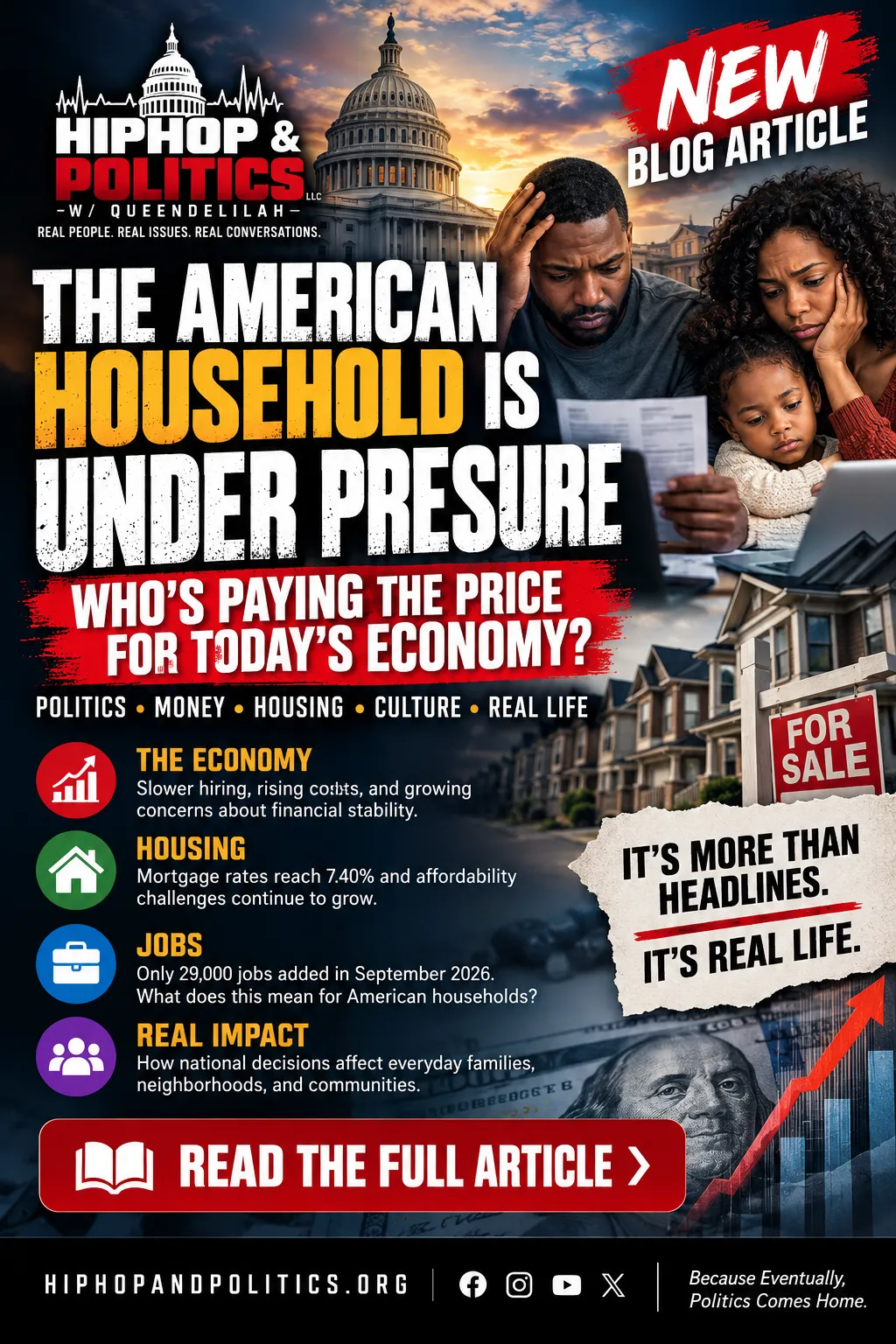
THE AMERICAN HOUSEHOLD IS UNDER PRESSURE: WHO'S PAYING THE PRICE FOR TODAY'S ECONOMY?
Politics • Money • Housing • Culture • Real Life
By HipHop & Politics Editorial Team | October 11, 2026
What happens when the economy looks stable on paper, but everyday Americans feel like they're falling further behind?
That's a question worth asking as we head toward the November 2026 midterm elections.
Across the country, families are making difficult decisions. Some are postponing homeownership. Others are reconsidering major purchases, stretching grocery budgets, or questioning whether their current income can support the life they're working to build.
Meanwhile, politicians debate economic performance, inflation, interest rates, and job creation.
But there's a difference between discussing the economy from a podium and experiencing it at the kitchen table.
At HipHop & Politics, that's where our conversation begins.
1. The Numbers Are Telling a Story
Recent economic reports raise important questions about the financial security of American households.
According to the U.S. Bureau of Labor Statistics, employers added just 29,000 jobs in September 2026, while unemployment stood at 4.2%.
Meanwhile, the Federal Reserve Bank of New York's October 7 report found that consumers expected prices to rise 3.9% over the following year. Expectations for household spending growth reached 5.5%, while perceptions of household financial well-being deteriorated.
And on October 9, Reuters reported that the University of Michigan's preliminary Consumer Sentiment Index had fallen to 46.3, reflecting growing concerns about living costs and the economic outlook.
These numbers don't mean every American is struggling equally.
But they reveal something important: economic growth and household financial security aren't always the same thing.
The real question isn't simply whether the economy is growing. It's whether the people contributing to that economy can afford to live in it.
2. Housing Is Becoming a Bigger Part of the Conversation
For many Americans, homeownership represents stability, independence, and an opportunity to build long-term wealth.
But the cost of entering the housing market continues to create obstacles.
On October 8, Freddie Mac reported that the average 30-year fixed mortgage rate reached 7.40%, up from 7.28% the previous week.
Higher borrowing costs can reduce purchasing power, even when home prices remain unchanged.
And for existing homeowners, rising insurance premiums, property taxes, maintenance expenses, and other ownership costs can create additional financial pressure.
Housing affordability isn't just a concern for first-time buyers.
It affects renters trying to save, families hoping to relocate, older homeowners on fixed incomes, and young adults questioning whether ownership will ever be realistic.
When housing becomes increasingly difficult to afford, the consequences extend beyond real estate. They affect family planning, mobility, savings, and neighborhood stability.
That's why housing policy deserves attention from everyone—not just people currently shopping for a home.
3. Jobs Matter, but So Does the Purchasing Power of a Paycheck
A paycheck is important.
But what matters just as much is what that paycheck can actually purchase.
Imagine a household where income increases slightly, but the combined costs of housing, food, transportation, insurance, and utilities rise faster.
That family may technically earn more money while having less financial flexibility.
This is why conversations about employment must go beyond how many jobs exist.
We should also be asking:
Are wages keeping pace with the cost of living?
Are communities attracting sustainable employment opportunities?
Can small businesses afford to hire and retain employees?
Are workers gaining access to training that leads to better-paying careers?
Are economic opportunities reaching neighborhoods that have historically experienced underinvestment?
A healthy economy should create pathways for people to improve their financial circumstances—not simply survive from one paycheck to the next.
4. Politics Doesn't Stop at the Ballot Box
With the November 3 midterm elections approaching, economic concerns are increasingly part of the national political conversation.
Different political leaders offer different explanations and solutions.
Some emphasize tax policy, deregulation, domestic energy production, and business investment as ways to encourage economic growth.
Others prioritize wage protections, affordable housing initiatives, public investment, and assistance for financially strained households.
Each approach raises legitimate questions about costs, benefits, implementation, and long-term results.
But voters deserve more than campaign slogans.
They deserve to understand what proposed policies actually do, who benefits, how programs will be funded, and what trade-offs may follow.
And that responsibility doesn't belong to only one political party.
Accountability should follow the decisions being made, regardless of who's making them.
Before supporting any economic proposal, we should be asking:
What is the actual policy? What evidence supports it? How will success be measured? And how will it affect the households expected to live with the results?
5. Why Community Voices Belong in This Conversation
National economic reports are important, but they don't capture every experience.
A restaurant owner facing higher operating costs may experience the economy differently from a salaried employee.
A renter preparing for a lease renewal may have different concerns than a homeowner whose insurance costs are increasing.
A college graduate entering the workforce may see opportunities and obstacles differently from someone approaching retirement.
These experiences deserve to be heard.
Not because every opinion is automatically correct, but because meaningful public discussion requires listening, asking questions, examining evidence, and understanding how policies affect different people.
Community conversations can also help identify practical solutions.
Sometimes that means sharing information about workforce programs, housing assistance, financial education, small-business resources, or local government meetings.
Other times, it means asking elected officials difficult but necessary questions.
The purpose isn't to create more political division. It's to create more informed participation.
6. What Can American Households Do Right Now?
While larger economic challenges require decisions from businesses, institutions, and government leaders, individuals can take practical steps to strengthen their position.
Review your household budget. Identify which expenses have increased and where adjustments may create financial flexibility.
Understand your housing costs. Rent or mortgage payments are only part of the picture. Consider insurance, taxes, utilities, maintenance, and other recurring expenses.
Explore workforce and business resources. Local workforce boards, community colleges, business development organizations, and nonprofit programs may provide useful opportunities.
Pay attention to local government. City and county decisions influence housing development, infrastructure, public safety, and community services.
Research candidates and policies. Compare official proposals, independent reporting, voting records where applicable, and measurable results.
Participate in community conversations. Ask questions, listen to differing viewpoints, and share verified resources.
None of these steps eliminates the broader affordability challenges facing Americans.
But information can help people make more deliberate decisions and participate more effectively in shaping their communities.
7. Our Position: The American Household Deserves to Be Part of the Discussion
At HipHop & Politics, we believe politics should be discussed through the experiences of the people affected by it.
Not every conversation needs to begin with political parties.
Sometimes it begins with a parent reviewing household expenses.
A young adult trying to find affordable housing.
A business owner deciding whether to hire another employee.
Or a family asking whether the opportunities available today will create a better future for the next generation.
These aren't separate from politics.
They're part of why politics matters.
Our commitment is to examine issues, challenge assumptions, encourage independent thinking, and create space for perspectives that don't always make the headlines.
Because the American household shouldn't be an afterthought in conversations about the American economy.
And when the headlines fade, the consequences of public decisions often remain.
🎙️ JOIN THE CONVERSATION: THE PEOPLE'S MIC
We're bringing this discussion directly to our community.
THE PEOPLE'S MIC — EVERY THURSDAY AT 8 PM EASTERN
Join HipHop & Politics w/ QueenDelilah for open conversations about jobs, housing, public safety, politics, community resources, and the issues affecting everyday life.
You don't have to be an expert.
You just have to be willing to participate, ask questions, and respect different perspectives.
REGISTER FOR FREE:
https://api.leadconnectorhq.com/widget/form/gMhg4AZfxDuB5u0ghsA6
HipHop & Politics
Real People. Real Issues. Real Conversations.
Because Eventually, Politics Comes Home.